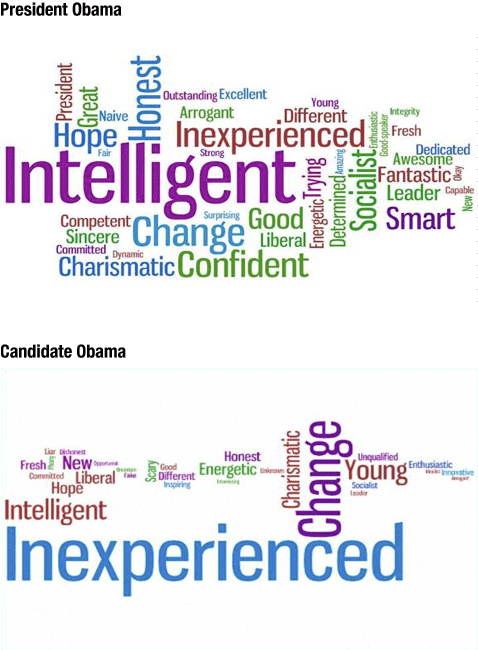
All three leading Democratic candidates bought substantial airtime on Iowa television last night, the Iowa Caucus Eve. While both Obama and Clinton appear in a one-on-one sitdown with the Iowa electorate to deliver their closing arguments, John Edwards doesn't even appear in his closing ad. Instead, he has Iowan Doug Bishop explain Edwards' promise to Bishop's young son, "I'm going to keep fighting for your daddy's job" as the reason he supports Edwards.
In my opinion, the choice to have an average American deliver a testimonial on his behalf, was the more powerful of the three Democratic ads.
Obama lightheartedly lets Iowans know "you'll be glad to know this will be one of the last times you'll here me say, "I'm Barack Obama and I approved this message""... and then goes on to explain why he is running for president. "I'm running to finally solve the problems we talk about year after year after year..."
Hillary's ad, called Crossroads delivers a litany of issues facing the nation's next president. But the MSM seems to be more fascinated by the "extreme makeover" and good lighting of the softer, gentler Hillary than the substance of the message.


Thursday, January 3, 2008


Tuesday, January 1, 2008
NYT: Iowa May Provide Dems Few Answers
Adam Nagourney poses the question: What if Iowa Settles Nothing for Democrats? by describing the Jan 3rd caucuses with, "Rarely has a political event been so intensely anticipated as a decisive moment, at least on the Democratic side."
Really? I was always under the impression Iowa was the first step in a long (but very shortened this cycle) series of elections designed to determine the Democratic nominee. Despite Michelle Obama's misguided statement of Iowa being "make or break" and the political chattering classes saying a Hillary win would be tantamount to sealing the deal, I think a process that moves on to the other early states (and, hopefully to at least Tsunami Tuesday) with two or three viable candidates will make the eventual nominee stronger as a general election candidate.
Despite Mr. Nagourney's concerns, if there are three Senators still standing on Friday morning, it will be a good day for Democrats. It will be a good day for America.
Really? I was always under the impression Iowa was the first step in a long (but very shortened this cycle) series of elections designed to determine the Democratic nominee. Despite Michelle Obama's misguided statement of Iowa being "make or break" and the political chattering classes saying a Hillary win would be tantamount to sealing the deal, I think a process that moves on to the other early states (and, hopefully to at least Tsunami Tuesday) with two or three viable candidates will make the eventual nominee stronger as a general election candidate.
Despite Mr. Nagourney's concerns, if there are three Senators still standing on Friday morning, it will be a good day for Democrats. It will be a good day for America.
Political Junkies' Nirvana
The Iowa newspaper of record, The Des Moines Register has released a new poll in the closing days before the caucuses illustrating once again why this may be the best of times for self-described political junkies like myself.
The contest is TOO CLOSE TO CALL. Make that BOTH contests.
I'm not sure if it could get any better than this - except to say the quick succession of primary contests means the nomination battle's frantic race to the (likely) Tsunami Tuesday finish line will mean the rollercoaster ride will be far too short.
The top Democratic headline from the DMR: "New Iowa Poll: Obama Widens Lead Over Clinton" announces Obama has opened the largest lead (32%-25% over Clinton) any candidate has enjoyed over the course of the year-long campaign in the Hawkeye State. But David Yepsen, the journalistic dean of Iowa politics writes (in the same Register) about the risk of making predictions from this poll.
The contest is TOO CLOSE TO CALL. Make that BOTH contests.
I'm not sure if it could get any better than this - except to say the quick succession of primary contests means the nomination battle's frantic race to the (likely) Tsunami Tuesday finish line will mean the rollercoaster ride will be far too short.
The top Democratic headline from the DMR: "New Iowa Poll: Obama Widens Lead Over Clinton" announces Obama has opened the largest lead (32%-25% over Clinton) any candidate has enjoyed over the course of the year-long campaign in the Hawkeye State. But David Yepsen, the journalistic dean of Iowa politics writes (in the same Register) about the risk of making predictions from this poll.
- Some support is soft. Of those who have decided on a candidate, 34 percent of the Democrats say they could still be persuaded to change their minds. Among Republicans, it's 46 percent.
- A lot of caucus-goers are first-timers. A whopping 60 percent of the Democrats say this would be their first time at a caucus. Some 40 percent of the Republicans say that.
- A lot of Democratic caucus-goers aren't all that Democratic. Some 40 percent of the Democratic caucus-goers say they are independents, and another 5 percent say they are Republicans. (Technically, they'll all have to re-register as Democrats to participate, but that can be done at the caucus site.) Put another way, 54 percent of the Democratic caucus-goers say they're Democrats. In 2004, it was 80 percent.
What this all means is Obama's "widening lead" is built on a very soft (and unpredictable) foundation. Many other polls taken during the same period weight previous caucus-goers more heavily. These polls continue to show a tight three-way race. Any of the leading campaigns can build a strong case for finishing first Thursday night.
Digging deeper into the numbers, it's interesting to see the issues divide between the GOP and Dem voters going into the caucuses. Immigration looms large on the Republican side while only 3% mention healthcare as an issue. Only 3% of Democrats are concerned about immigration; they're motivated by the war in Iraq and healthcare.
As a Democrat,the best news from the DMR poll may be this nugget (again from Yepsen):
* Democrats are on fire. And what if 40 percent of the Democratic caucus-goers are independents and 5 percent are Republicans? That tells us the GOP is in real trouble, that a lot of Americans want change and that they are turning to the Democrats to find it.
"Hold on, boys and girls, strap yourselves in and please keep your arms and legs inside the car. This rollercoaster is going to be unlike any other you've ever been on."
Monday, December 31, 2007
As I See It: The Democratic Nomination
Democrats are blessed this New Year.
We have a field of presidential candidates unmatched in American history. The Iowa caucuses loom less than 72 hours away and - for the most part - we are debating our candidates' strengths. Who is the most electable? Who has the most valuable experience? Who can unite a nation and enact change?
It may have at times seemed dirty and nasty (and may get moreso in the weeks preceding Tsunami Tuesday) but all one has to do is look at what's happening on the other side to realize the Democratic campaign is about a positive vision for America's future. The Republicans? Not so much.
How does one choose from this qualified and diverse candidate roster? To me, it comes down to this central question:
Do I want a "uniter" who will moderate to the middle (Obama) or do I want a "fighter" who will have the determination to implement truly progressive liberal reforms (Edwards) to be the Democratic Party's nominee?
"Turning the page" on the past two decades' partisan warfare is well and good, as long as the nation is led into it's next progressive chapter, united in purpose to restore the American Dream.
I have less faith in Obama's ability to move to the nation in the progressive direction and that is why I believe Edwards would be our strongest standard-bearer.
We have a field of presidential candidates unmatched in American history. The Iowa caucuses loom less than 72 hours away and - for the most part - we are debating our candidates' strengths. Who is the most electable? Who has the most valuable experience? Who can unite a nation and enact change?
It may have at times seemed dirty and nasty (and may get moreso in the weeks preceding Tsunami Tuesday) but all one has to do is look at what's happening on the other side to realize the Democratic campaign is about a positive vision for America's future. The Republicans? Not so much.
How does one choose from this qualified and diverse candidate roster? To me, it comes down to this central question:
Do I want a "uniter" who will moderate to the middle (Obama) or do I want a "fighter" who will have the determination to implement truly progressive liberal reforms (Edwards) to be the Democratic Party's nominee?
"Turning the page" on the past two decades' partisan warfare is well and good, as long as the nation is led into it's next progressive chapter, united in purpose to restore the American Dream.
I have less faith in Obama's ability to move to the nation in the progressive direction and that is why I believe Edwards would be our strongest standard-bearer.
Rothenberg: Edwards More of a Divider Than Dubya (Say What?)
Political commentator Stuart Rothenberg calls John Edwards a "divider" by declaring: "his (Edwards') approach to problems is likely to frighten many voters, including most middle class Americans and virtually all Republicans."
Is this a last-minute effort by the Inside the Beltway punditocracy to derail Edwards' electability argument? David Sirota seems to think so. In a post over at DailyKos Sirota writes the rise of populist candidates in both the Democratic and Republican primaries is causing full-scale panic in the exclusive salons of the DC Chattering Classes.
Rothenberg makes an astonishing prediction (emphasis mine)
The punditocracy is failing to connect the dots. The populist message is appealing to voters across the political spectrum. How else can one explain libertarian Ron Paul's wild fundraising success, Huckabee (and Edwards) populist-fueled Iowa surges and the flailing campaigns of the deep-pocketed establishment candidates? Rothenberg failes to acknowledge that an Edwards Administration, if it materializes, will likely be sworn in with a stronger progressive Congressional majority in Jan 2009. The election's mandate could be stronger than any seen since the 1980s.
There is a growing discontent and deep unease afflicting America's middle and working classes. Health care, education, and the economy - Democrats' bread and butter issues - are rising to the top of voter concerns. The candidates addressing these issues most directly are the ones gaining traction as the first votes approach. This doesn't mean the populist insurgencies will eventually win the nominations, but it does illustrate the two divergent worldviews of the Inside The Beltway Bubble and the rest of America.
Is this a last-minute effort by the Inside the Beltway punditocracy to derail Edwards' electability argument? David Sirota seems to think so. In a post over at DailyKos Sirota writes the rise of populist candidates in both the Democratic and Republican primaries is causing full-scale panic in the exclusive salons of the DC Chattering Classes.
Rothenberg makes an astonishing prediction (emphasis mine)
But let’s be very clear: Given the North Carolina Democrat’s rhetoric and agenda, an Edwards Presidency would likely rip the nation apart – even further apart than Bush has torn it.
On Capitol Hill, Edwards’s “us versus them” rhetoric and legislative agenda would almost certainly make an already bitter mood even worse. He would in the blink of an eye unify the GOP and open up divisions in his own party’s ranks. Congressional Republicans would circle the wagons in an effort to stop Edwards’s agenda.
The punditocracy is failing to connect the dots. The populist message is appealing to voters across the political spectrum. How else can one explain libertarian Ron Paul's wild fundraising success, Huckabee (and Edwards) populist-fueled Iowa surges and the flailing campaigns of the deep-pocketed establishment candidates? Rothenberg failes to acknowledge that an Edwards Administration, if it materializes, will likely be sworn in with a stronger progressive Congressional majority in Jan 2009. The election's mandate could be stronger than any seen since the 1980s.
There is a growing discontent and deep unease afflicting America's middle and working classes. Health care, education, and the economy - Democrats' bread and butter issues - are rising to the top of voter concerns. The candidates addressing these issues most directly are the ones gaining traction as the first votes approach. This doesn't mean the populist insurgencies will eventually win the nominations, but it does illustrate the two divergent worldviews of the Inside The Beltway Bubble and the rest of America.
Sunday, December 30, 2007
The Delegate Dash Is On
before the first votes are cast in America's Heartland, Hillary is ahead in SuperDelegates - proving the Democratic establishment has gathered in the Clinton Corner.
According to ABC's survey the totals are:
DELEGATES
Clinton 158
Obama 89
Edwards 26
Richardson 20
Dodd 15
Biden 8
Kucinich 1
Gravel 0
Since these delegates are free to change their minds, it will be interesting to see if the voting in Iowa and New Hampshire alters these totals.
According to ABC's survey the totals are:
DELEGATES
Clinton 158
Obama 89
Edwards 26
Richardson 20
Dodd 15
Biden 8
Kucinich 1
Gravel 0
Since these delegates are free to change their minds, it will be interesting to see if the voting in Iowa and New Hampshire alters these totals.
Tuesday, December 18, 2007
Nine Out of Ten American Voters Surveyed Agree:
It's rare during this time of increased partisanship to find the American electorate agreeing on anything, but this morning a new presidential preference poll from USA Today/Gallup reveals a surprising consensus among American voters. Granted, the headlines from the poll are likely to be about a modest bounce in support for Hillary Clinton and a shift among Democratic voters towards nominating the "most electable" general election candidate.
But buried deeper in the poll is an intriguing number: Nine out of ten voters today say it makes a real difference to them who is elected president. This represents a huge swing (of more than 30 points) compared to polling data from previous election cycles:
A. Does it make a real difference to you who is elected president, or not?
But buried deeper in the poll is an intriguing number: Nine out of ten voters today say it makes a real difference to them who is elected president. This represents a huge swing (of more than 30 points) compared to polling data from previous election cycles:
A. Does it make a real difference to you who is elected president, or not?
| DATE | Yes | No | No opinion |
|---|---|---|---|
| 2007 Dec 14-16 | 90 | 10 | 0 |
| 2000 Mar 10-12 | 60 | 35 | 5 |
| 2000 Jan 7-10 | 54 | 37 | 9 |
| 1996 May 9-12 | 57 | 40 | 3 |
| 1992 Oct 23-25 | 76 | 22 | 2 |
| 1992 Sep 11-15 | 66 | 30 | 4 |
| 1992 Apr 20-22 | 53 | 43 | 4 |
| 1992 Feb 28-Mar 1 | 53 | 42 | 5 |
| 1992 Jan 6-9 | 60 | 30 | 10 |
Only in the closing weeks of the 1992 general election campaign did more than 2/3 of voters share the sentiment. Perhaps this number is a confirmation of the view 2008 may be truly be a "change election."
I can offer up three possible explanations for this change:
1) It is an indictment of the Bush administration's failed policies which have adversely affected the daily lives of American families. Even the most casual voter understands the stakes in the 2008 presidential election.
2) It is a reflection of the increased partisanship that has become a fixture in American politics over the past fifteen years. As we've gone to our separate corners and divided ourselves further apart on the ideological spectrum, the stark differences in governing philosophies have increased the importance of who resides at 1600 Pennsylvania Avenue.
3) The Global War on Terror is more than a bumper sticker slogan. Perhaps 9/11 did change everything. Since the USA Today poll doesn't include data for the 2004 cycle, perhaps this shift happened during the last cycle. If this is the case, I'm afraid we may end up with a President Rudy.
Any other explanations?
Subscribe to:
Posts (Atom)