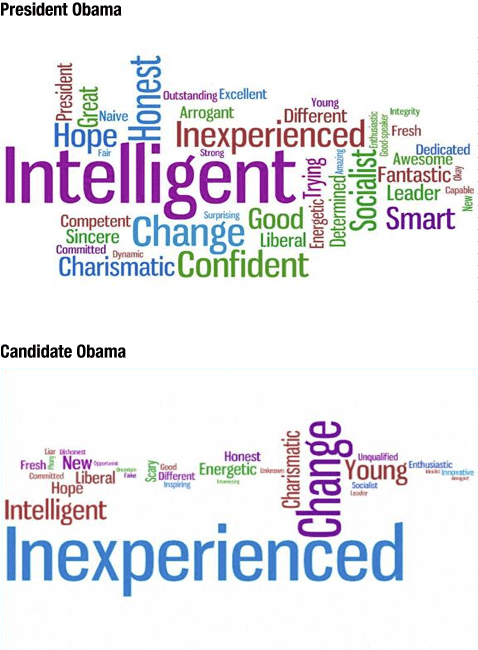
Despite President Obama's Team of Rivals embrace of his vanquished primary foe, former surrogates are trying to stir up the old intraparty rivalry in this year's most critical Democratic primary - the Virginia gubernatorial race. The Clinton's uber-fundraiser and former DNC Chair Terry McAuliffe is using his high-profile relationships to raise oodles of money. His path to vicotry depends on using that money to increase voter turnout beyond the traditional primary electorate. The off-off-off year elections in Virginia typically attract only the most committed partisans. Brian Moran, on the other hand, is hoping to claim Obama's message of change and motivate the liberal activists to carry him to victory.
Despite the apparent unwillingness of Obama to engage in this skirmish, it's fascinating to see whether activists and the grassroots still cling to old loyalties. Will a McAuliffe victory be viewed by Hillary allies as a restoration of the old Democratic order? Will some see a Moran triumph as a final Clinton smackdown? What would a Creigh Deeds victory mean?


Showing posts with label Hillary. Show all posts
Showing posts with label Hillary. Show all posts
Monday, May 11, 2009


Sunday, June 24, 2007
Hillary Doesn't Prefer Blondes! More Meaningless News From the Sunday Morning Pundits
Sunday mornings at Chrispy's home have a predictable routine. This week was like most others...until I heard something about blondes...and brunettes...and I soon found myself wondering, "Is this what passes for a real discussion about issues and politics in 21st century America?"
Now, I'm no Hillary fan, but I found myself wondering, is this fair?
For nearly two decades I lived in DC, and I religiously watched the Sunday morning talkshow lineup (Inside the Beltway they conveniently schedule the shows so you can watch one after the other - its the politico's version of NFL football). When I moved to the West Coast, I realized my weekly political junkie fix would be limited (three years later, I still haven't succeeded in locating CBS's Face the Nation). As a result, Meet the Press and the Chris Mathews Show provide my Sunday morning political insider 'spin.'
This Sunday's Meet the Press had a segment titled "Slick Hillary" in which Timmy and the gang talked about Ron Fornier's recent article describing Hillary's political skills as less "slick" but not as "slick" as 'uber-political' husband Bill.
Stop the presses, folks.
Let's be fair here - and acknowledge there are 20 candidates in the field with political instincts that are no match for Bill Clinton. Hillary isn't going to measure up to him, but neither are any of the others.
As far as being "too slick," PBS's Gwen Ifill came to Hillary's rescue by observing,
Oh, but I made the mistake of leaving the TV on too long and wound up catching Chris Matthews and his gang of merry misfits. Misogynist TweetyBird took particular delight in devouring Hillary this week - but it was the WaPo's Kathleen Parker that really shocked me when she commented on a recent front page picture in the WaPo accompanying an article about the role of women in Clinton's presidential campaign by saying:
Now, I'm no Hillary fan, but I found myself wondering, is this fair?
For nearly two decades I lived in DC, and I religiously watched the Sunday morning talkshow lineup (Inside the Beltway they conveniently schedule the shows so you can watch one after the other - its the politico's version of NFL football). When I moved to the West Coast, I realized my weekly political junkie fix would be limited (three years later, I still haven't succeeded in locating CBS's Face the Nation). As a result, Meet the Press and the Chris Mathews Show provide my Sunday morning political insider 'spin.'
This Sunday's Meet the Press had a segment titled "Slick Hillary" in which Timmy and the gang talked about Ron Fornier's recent article describing Hillary's political skills as less "slick" but not as "slick" as 'uber-political' husband Bill.
Stop the presses, folks.
Let's be fair here - and acknowledge there are 20 candidates in the field with political instincts that are no match for Bill Clinton. Hillary isn't going to measure up to him, but neither are any of the others.
As far as being "too slick," PBS's Gwen Ifill came to Hillary's rescue by observing,
"Guess what? Almost every other candidate in this race has some sort of 'slickness' which has been attributed to them - from Mitt Romney to Rudy Giuliani to Barack Obama. And guess what? It turns out that that doesn't matter as much to people as the issues which concern them. How are they going to get their kids in school? How are they going to get their healthcare paid for? So, even though it infuriates us - the media... I don't know that there is any evidence that voters are sitting here thinking, 'Well, I don't know what she thinks, I'll have to vote for somebody else.'"Amen, Gwen.
Oh, but I made the mistake of leaving the TV on too long and wound up catching Chris Matthews and his gang of merry misfits. Misogynist TweetyBird took particular delight in devouring Hillary this week - but it was the WaPo's Kathleen Parker that really shocked me when she commented on a recent front page picture in the WaPo accompanying an article about the role of women in Clinton's presidential campaign by saying:
"It makes a case with a certain demographic, and I noticed the picture on the front of The Washington Post the other day showed her with all these women and her crew, and did you notice, there was only one blonde out of about 15 women, so it sort of -- I thought that was very telling."
The photo in question can be found here. And, yes, there's only one blonde. Not sure what that says about Hillary's qualifications to be president, but Ms. Parker found it noteworthy.
Most troubling is that this answer came during Tweety's line of questioning about Hillary's qualifications to be Commander-in-Chief, which he prefaced by this comment:
OK, let's put the gender thing in here. I love gender politics, guys. We have two women here all the time to make sure we're balanced on this show. But Elisabeth, I know you're a feminist, in the best possible sense of that word. You [Parker] probably are in a more traditional word.
I found myself wondering, "WTF? What does Matthews mean by "you're a feminist in the best possible sense of that word?" And, if Parker's more "traditional" feminism means making vapid observations about hair color, I can only shake my head in utter dismay. Who cares about the hair color of the women on Hillary's team?" I can't believe this passes for political discourse in modern America.
Twelve hours later, as I tuck myself into bed, the late-night local news reports there are 23 million single women in America today. They are likely to be the 2008 version of Soccer Moms and NASCAR dads, the anchor tells me.
"Oh, please," I find myself begging, "don't let them care how many blondes the next president has in their cabinet. "
Can't we do better than this? Doesn't America deserve more?
Saturday, June 16, 2007
Could the Democrats Lose the White House (again) in 2008?
Conventional wisdom predicts a Democratic jaunt to the White House next year. With a disastrous war and incompetent administration, the GOP brand is in disarray. The Democratic base is energized. Democratic primary voters tell pollsters they are satisfied with the talented and diverse field of candidates currently competing for the party nomination.
Why then, is Camille Paglia writing in her Salon.com column "Don't run, Al. Don't!" about what she sees "as Republican momentum toward next year's national election?" (Yup, it looks like she's been back at Salon since Valentine's Day. I'm surprised it took me that long to notice. Perhaps the Salon editors were looking for something to counterbalance the rational, thoughtful and insightful musings of Glenn Greenwald.)
I have to admit to a morbid fascination with Paglia's commentary. She plays the part of agent provocateur perfectly: a pseudo-feminist, democratic libertarian, martial hedonist who relishes her ability to stir things up, never endearing herself to the left or the right. Her style is one I would never choose for myself. More often than not, I do not agree with her. But I have to admit, I'm almost always entertained and challenged.
I saw the headline and clicked, wondering, "What's Camille got to say about Al?"
Apparently, a lot. But, she's got even more to say about Hillary. It turns out the story is not primarily about whether or not Gore should launch a bid. It's actually about what the "Draft Al" movement reveals about the Democratic nomination battle. She uses the "Draft Al" movement as evidence the Democratic base is NOT satisfied with current choices, stating "the Gore boomlet betrays subterranean tremors of doubt."
Oh, so that's it. We're going to read about the dismal state of the Democratic Party nomination battle. Well, at least I'm going to be challenged this time. I'm pretty sure I'm not going to be entertained.
Although Paglia certainly tries. She launches into her typical commentary, jumping disjointedly from one thought to the next. Not surprisingly, she holds no punches. The current crop of candidates has failed to impress her in the opening debates. "Wait, I wonder, is she now arguing there's a place for Gore in this campaign?" I check the headline again. Hmmm...
She savages Hillary (and makes sure to hit Bill, too, for old times sake). She belittles Edwards and Obama. With the possible exception of Kucinich, the Democrats are a bunch of "girly-men." OK, she doesn't use the governator's term, but she's essentially delivering the same message. She observes:
But, does the "Draft Al" movement reveal a sense of dissatisfaction within the Democratic Party? I'm not so sure. Paglia simply throws the comment out with "shudders of deja vu." She provides little else to support her claim. She ignores the vast amounts of money the leading Democrats raised in the first quarter. She conveniently overlooks the vastly larger audiences watching the Democratic debates. All of this must be unimportant.
She expends quite a bit of energy beating up the leading candidates - while offering minimal advice to the current candidates and failing to offer any viable alternatives.
Paglia fails to entertain AND challenge this time.
I have my opinion about Gore's 20008 plans and chances. He should run IF he wants to, the odds for him winning the White House are better than anyone else out there, BUT he needs to be in the race before the end of September. I would consider supporting him, but I lean towards John Edwards. I myself believe a diverse primary contest strengthens the eventual nominee, in most cases. I state these opinions simply to let the reader know where I stand; I believe they are irrelevant to this post's central topics.
I'm wondering two things:
1) Is the Democratic Party overconfident going into 2008?
2) Does the "Draft Al" movement reveal dissatisfaction in the Democratic ranks?
Cross posted at My Left Wing.
Why then, is Camille Paglia writing in her Salon.com column "Don't run, Al. Don't!" about what she sees "as Republican momentum toward next year's national election?" (Yup, it looks like she's been back at Salon since Valentine's Day. I'm surprised it took me that long to notice. Perhaps the Salon editors were looking for something to counterbalance the rational, thoughtful and insightful musings of Glenn Greenwald.)
I have to admit to a morbid fascination with Paglia's commentary. She plays the part of agent provocateur perfectly: a pseudo-feminist, democratic libertarian, martial hedonist who relishes her ability to stir things up, never endearing herself to the left or the right. Her style is one I would never choose for myself. More often than not, I do not agree with her. But I have to admit, I'm almost always entertained and challenged.
I saw the headline and clicked, wondering, "What's Camille got to say about Al?"
Apparently, a lot. But, she's got even more to say about Hillary. It turns out the story is not primarily about whether or not Gore should launch a bid. It's actually about what the "Draft Al" movement reveals about the Democratic nomination battle. She uses the "Draft Al" movement as evidence the Democratic base is NOT satisfied with current choices, stating "the Gore boomlet betrays subterranean tremors of doubt."
Oh, so that's it. We're going to read about the dismal state of the Democratic Party nomination battle. Well, at least I'm going to be challenged this time. I'm pretty sure I'm not going to be entertained.
Although Paglia certainly tries. She launches into her typical commentary, jumping disjointedly from one thought to the next. Not surprisingly, she holds no punches. The current crop of candidates has failed to impress her in the opening debates. "Wait, I wonder, is she now arguing there's a place for Gore in this campaign?" I check the headline again. Hmmm...
She savages Hillary (and makes sure to hit Bill, too, for old times sake). She belittles Edwards and Obama. With the possible exception of Kucinich, the Democrats are a bunch of "girly-men." OK, she doesn't use the governator's term, but she's essentially delivering the same message. She observes:
After two major televised debates by both parties, only a Pollyanna on helium would believe that any of the top-tier Democrats will definitely be able to defeat a leading Republican like Mitt Romney or Rudy Giuliani.I think it's far too early in the campaign to draw conclusions regarding general election matchups. I do, however, recognize there are quite a few Pollyannas running around these days, particularly among the denizens of the progressive blogosphere. "Too many Democrats seem to believe that their party will simply sail into the White House in 2008," Paglia writes. On this point, I couldn't agree more. This overconfidence is worrisome. I'm not sure there is much we can do about it, but we all need to understand that winning the White House in 2008 is not a done deal.
But, does the "Draft Al" movement reveal a sense of dissatisfaction within the Democratic Party? I'm not so sure. Paglia simply throws the comment out with "shudders of deja vu." She provides little else to support her claim. She ignores the vast amounts of money the leading Democrats raised in the first quarter. She conveniently overlooks the vastly larger audiences watching the Democratic debates. All of this must be unimportant.
She expends quite a bit of energy beating up the leading candidates - while offering minimal advice to the current candidates and failing to offer any viable alternatives.
Paglia fails to entertain AND challenge this time.
I have my opinion about Gore's 20008 plans and chances. He should run IF he wants to, the odds for him winning the White House are better than anyone else out there, BUT he needs to be in the race before the end of September. I would consider supporting him, but I lean towards John Edwards. I myself believe a diverse primary contest strengthens the eventual nominee, in most cases. I state these opinions simply to let the reader know where I stand; I believe they are irrelevant to this post's central topics.
I'm wondering two things:
1) Is the Democratic Party overconfident going into 2008?
2) Does the "Draft Al" movement reveal dissatisfaction in the Democratic ranks?
Cross posted at My Left Wing.
Wednesday, June 13, 2007
The Democratic Primaries - Hillary's Road to Victory
Originally posted at Daily Kos on May 23, 2007.
"In America any boy may become President and I suppose it's just one of the risks he takes." ~Adlai Stevenson
Today, four score and seven years after the battle for female suffrage was won, little girls can dream of becoming president thanks to Sen. Clinton's trailblazing path toward the 2008 Democratic presidential nomination. It's time to revise Adlai's adage.
According to the national and state polls, it is clear Hillary is the frontrunner at this early stage. She's got the money, name recognition, and institutional support to secure the nomination on February 5th. In fact, it could be argued that if she wins three of the four early contests (IA, NV, NH and SC), the race could be over before the Mardi Gras Primary.
Can Hillary vanquish Obama, Edwards, Richardson and the rest of the Democratic field so efficiently?
Of course, Democrats are notoriously fickle when it comes to frontrunners, as we tend to gravitate toward underdogs and show more affinity to insurgent campaigns than Republican primary voters traditionally do. Taking this into account, I've been wondering the following:
1) Will Hillary's frontrunner status be seriously challenged by the talented candidates in the field?
2) Does the frontloaded primary schedule make her victory inevitable? Or, could the enormous pot of convention delegates available on Feb 5, 2008 be stolen away from her if she stumbles in January?
In two previous diaries, I've contemplated how both Obama and Edwards could navigate the early primaries and knock Sen. Clinton from her lofty perch. From this vantage point, both Obama and Edwards, IMO, are aiming to position themselves going into into Super Duper Tuesday Feb 5th as viable alternatives to Hillary, creating a two or three candidate race. Neither Obama or Edwards will be able to effectively lay claim to the nomination prior to the Mardi Gras Primary.
But, Hillary can.
By sweeping the January contests, she could effectively have the nomination wrapped up BEFORE the Mega Primary. Of course, she won't mathmatically be able to accumulate the number of delegates to secure the nomination (less than 5% are available in the early contests) but, her institutional advantages will allow her to close the door on the competition if she avoids January stumbles.
I'm aware this view may not be well-received here at DKos. And before I get pilloried by the large contingent of Edwards, Obama, Gore, Richardson and the "ABC" (Anybody But Clinton) populations residing on this site, I am not a Clinton supporter. In fact, I worry about the polls showing Clinton as the weakest of the leading Democratic candidates in general election matchups. I'm not advocating on behalf of any of the candidates, at this point.
Two other caveats:
Gore candidacy - I am not including a Gore candidacy in this (or the Obama & Edwards) scenarios, as an entry by the VP would scramble all the campaign's strategies. I'm taking Gore at his word - and trying to determine what he REALLY plans on doing is simply a fun parlor game, at this point.
Florida primary - The DNC is still debating whether or not Florida will lose convention delegates, as a result of leapfrogging to Jan 29. The committee is also consdiering punishing candidates campaigning in the Sunshine State. For these reasons, I'm leaving Florida out of the calculus at this point. Once those questions are resolved, I'll revisit how Florida affects the strategies of each of the campaigns.
For much of the analysis and predictions in each of these diaries, I've used the most up to date public polls available.
JANUARY 2008
IOWA CAUCUSES - Monday 1/14/08 (tentative)
"CLINTON WINS FIRST CONTEST OF 2008 SEASON; STRONG STATE ORGANIZATION CREDITED IN VICTORY"
John Edwards has been ahead in the Iowa polls for months, with brief surges by both Clinton and Obama. Edwards' vast investment of time and energy in the Hawkeye State has paid off in his steady lead in the state polls but he hasn't pulled away from the pack, as his lead typically ranges between 2-10 points.
Iowa represents Edwards' best opportunity to derail the Hillary locomotive. Conversely, any finish other than first for Edwards likely dooms his campaign. For this reason, if Hillary can win in Iowa, the fight for the nomination would become a two-person battle.
NEXT STOP - NEVADA CAUCUSES Tuesday, 1/19/08
Nevada is an unknown variable in the 2008 campaign. Without a long history of participating in the caucus experience, identifying and developing an effective and strong network of activists is likely to be difficult for all the campaigns. Clinton has been building a national campaign and is aiming to overcome Edwards' efforts to win union support and Richardson's regional affinity and a win here would show the depth and strength of her national appeal.
Currently, the scarce polling shows (ARG - Dec 2006, Zogby - April 2007, and Mason-Dixon - May 2007) Hillary with a comfortable lead at this stage of the race. And, if Clinton wins the Iowa Caucuses, it is likely her victory will provide momentum in the Silver State. The wildcard may be NM Gov. Richardson, who could get a boost for his candidacy as the one westerner in the race (I'm not counting Gravel in this discussion, folks).
However, the most recent NV poll, from Mason-Dixon shows Hillary far ahead in Nevada, with both Edwards and Obama only measuring in the mid-teens, struggling to gain traction. In a state with no long-standing tradition of political engagement in the nominating process, Clinton's near-universal name recognition makes this a likely victory, especially if she pulls out a win in Iowa.
NEW HAMPSHIRE Tuesday, 1/22/08 (tentative)
"Hillary Ekes Out a Win in Granite State - Race Down to Clinton - Obama
The open primary in New Hampshire presents Sen. Obama his greatest opportunity to upset Clinton's momentum. Again, NH polls show Hillary comfortably ahead, with both Edwards and Obama jockeying for the number 2 position. According to Rasmussen polling, Obama attracts independents by a 2:1 margin. If the energy and excitement remains on the Democratic side, Obama could capitalize on this advantage and attract the independents to the Democratic polls and win. This far out, I'd estimate that Sen. Clinton would be the favorite to overcome this obstacle, particularly if IA and NV are already in her victory column. Her victory margin might be very slim, but as the old saying goes, "Close only counts in horseshoes and hand grenades."
SOUTH CAROLINA
The Battle Moves to Dixie - SC Primary Tuesday, 1/29/08 (tentative)
The African American vote makes up a large percentage of the primary vote in South Carolina. And, as witnessed this past March in Selma, Sens. Clinton and Obama are waging an all-out battle for the support of this community. I do think that Obama is likely to win either NH or SC, and from Hillary's perspective, South Carolina is the least damaging to her overall chances.
From a national perspective, South Carolina is not going to be "in play" for the Democrats in the general. And, if Clinton has already claimed victory in the three previous contests (all critical Swing States), she will have begun to silence the worry among Democratic voters about her ability to win in November. Additionally, an Obama win in South Carolina - if this is his first of the campaign - is likely going to be too little, too late.
It's important to note the delegate totals only reflect PLEDGED delegates resulting from the primary and caucus results.
And, even if Hillary's machine does stumble, they've got comprehensive strategy to woo the millions of absentee voters in California (who will be voting BEFORE Iowa's Caucuses - if present schedule remains as is) to create a firewall in case Clinton loses Iowa and/or New Hampshire. After all, there are more absentee voters in CA than the entire populations of some of the early voting statess. Ah, but that's another diary.
NEXT ON THE CALENDAR - FLORIDA - a bellwhether and kingmaker?
"In America any boy may become President and I suppose it's just one of the risks he takes." ~Adlai Stevenson
Today, four score and seven years after the battle for female suffrage was won, little girls can dream of becoming president thanks to Sen. Clinton's trailblazing path toward the 2008 Democratic presidential nomination. It's time to revise Adlai's adage.
According to the national and state polls, it is clear Hillary is the frontrunner at this early stage. She's got the money, name recognition, and institutional support to secure the nomination on February 5th. In fact, it could be argued that if she wins three of the four early contests (IA, NV, NH and SC), the race could be over before the Mardi Gras Primary.
Can Hillary vanquish Obama, Edwards, Richardson and the rest of the Democratic field so efficiently?
Of course, Democrats are notoriously fickle when it comes to frontrunners, as we tend to gravitate toward underdogs and show more affinity to insurgent campaigns than Republican primary voters traditionally do. Taking this into account, I've been wondering the following:
1) Will Hillary's frontrunner status be seriously challenged by the talented candidates in the field?
2) Does the frontloaded primary schedule make her victory inevitable? Or, could the enormous pot of convention delegates available on Feb 5, 2008 be stolen away from her if she stumbles in January?
In two previous diaries, I've contemplated how both Obama and Edwards could navigate the early primaries and knock Sen. Clinton from her lofty perch. From this vantage point, both Obama and Edwards, IMO, are aiming to position themselves going into into Super Duper Tuesday Feb 5th as viable alternatives to Hillary, creating a two or three candidate race. Neither Obama or Edwards will be able to effectively lay claim to the nomination prior to the Mardi Gras Primary.
But, Hillary can.
By sweeping the January contests, she could effectively have the nomination wrapped up BEFORE the Mega Primary. Of course, she won't mathmatically be able to accumulate the number of delegates to secure the nomination (less than 5% are available in the early contests) but, her institutional advantages will allow her to close the door on the competition if she avoids January stumbles.
I'm aware this view may not be well-received here at DKos. And before I get pilloried by the large contingent of Edwards, Obama, Gore, Richardson and the "ABC" (Anybody But Clinton) populations residing on this site, I am not a Clinton supporter. In fact, I worry about the polls showing Clinton as the weakest of the leading Democratic candidates in general election matchups. I'm not advocating on behalf of any of the candidates, at this point.
Two other caveats:
Gore candidacy - I am not including a Gore candidacy in this (or the Obama & Edwards) scenarios, as an entry by the VP would scramble all the campaign's strategies. I'm taking Gore at his word - and trying to determine what he REALLY plans on doing is simply a fun parlor game, at this point.
Florida primary - The DNC is still debating whether or not Florida will lose convention delegates, as a result of leapfrogging to Jan 29. The committee is also consdiering punishing candidates campaigning in the Sunshine State. For these reasons, I'm leaving Florida out of the calculus at this point. Once those questions are resolved, I'll revisit how Florida affects the strategies of each of the campaigns.
For much of the analysis and predictions in each of these diaries, I've used the most up to date public polls available.
In addition to the polls in the previous link, American Research Group (ARG) reports presidential preferences as fo April 30, 2007 as follows:
Democrats IA NH SC
Biden 6% 2% 3%
Clinton 23% 37% 36%
Edwards 27% 26% 18%
Obama 19% 14% 24%
Richardson 5% 3% 1%
Undecided 16% 15% 13%
any candidate not listed did not receive more than 3% in any of the states listed
JANUARY 2008
IOWA CAUCUSES - Monday 1/14/08 (tentative)
"CLINTON WINS FIRST CONTEST OF 2008 SEASON; STRONG STATE ORGANIZATION CREDITED IN VICTORY"
John Edwards has been ahead in the Iowa polls for months, with brief surges by both Clinton and Obama. Edwards' vast investment of time and energy in the Hawkeye State has paid off in his steady lead in the state polls but he hasn't pulled away from the pack, as his lead typically ranges between 2-10 points.
Iowa represents Edwards' best opportunity to derail the Hillary locomotive. Conversely, any finish other than first for Edwards likely dooms his campaign. For this reason, if Hillary can win in Iowa, the fight for the nomination would become a two-person battle.
DELEGATE COUNT -
assuming IA results: Clinton 30%, Edwards 28%, Obama 26%
45 pledged delegates at stake
Clinton - 21
Edwards - 13
Obama - 12
NEXT STOP - NEVADA CAUCUSES Tuesday, 1/19/08
Nevada is an unknown variable in the 2008 campaign. Without a long history of participating in the caucus experience, identifying and developing an effective and strong network of activists is likely to be difficult for all the campaigns. Clinton has been building a national campaign and is aiming to overcome Edwards' efforts to win union support and Richardson's regional affinity and a win here would show the depth and strength of her national appeal.
Currently, the scarce polling shows (ARG - Dec 2006, Zogby - April 2007, and Mason-Dixon - May 2007) Hillary with a comfortable lead at this stage of the race. And, if Clinton wins the Iowa Caucuses, it is likely her victory will provide momentum in the Silver State. The wildcard may be NM Gov. Richardson, who could get a boost for his candidacy as the one westerner in the race (I'm not counting Gravel in this discussion, folks).
However, the most recent NV poll, from Mason-Dixon shows Hillary far ahead in Nevada, with both Edwards and Obama only measuring in the mid-teens, struggling to gain traction. In a state with no long-standing tradition of political engagement in the nominating process, Clinton's near-universal name recognition makes this a likely victory, especially if she pulls out a win in Iowa.
DELEGATE COUNT - assuming NV results Clinton 35%, Obama 25%, Edwards 15%, Richardson 15%
25 pledged delegates at stake
NV Prev Total Clinton 11 21 32 Obama 6 12 18 Edwards 4 13 17 Richardson 4 0 4
NEW HAMPSHIRE Tuesday, 1/22/08 (tentative)
"Hillary Ekes Out a Win in Granite State - Race Down to Clinton - Obama
The open primary in New Hampshire presents Sen. Obama his greatest opportunity to upset Clinton's momentum. Again, NH polls show Hillary comfortably ahead, with both Edwards and Obama jockeying for the number 2 position. According to Rasmussen polling, Obama attracts independents by a 2:1 margin. If the energy and excitement remains on the Democratic side, Obama could capitalize on this advantage and attract the independents to the Democratic polls and win. This far out, I'd estimate that Sen. Clinton would be the favorite to overcome this obstacle, particularly if IA and NV are already in her victory column. Her victory margin might be very slim, but as the old saying goes, "Close only counts in horseshoes and hand grenades."
DELEGATE COUNT - assuming NH results Clinton 37%, Obama 35%, Edwards 10%, Richardson 10%
22 pledged delegates at stake
NH Prev Total Clinton 14 32 46 Obama 8 18 26 Edwards 0 17 17 Richardson 0 0 4
SOUTH CAROLINA
The Battle Moves to Dixie - SC Primary Tuesday, 1/29/08 (tentative)
The African American vote makes up a large percentage of the primary vote in South Carolina. And, as witnessed this past March in Selma, Sens. Clinton and Obama are waging an all-out battle for the support of this community. I do think that Obama is likely to win either NH or SC, and from Hillary's perspective, South Carolina is the least damaging to her overall chances.
From a national perspective, South Carolina is not going to be "in play" for the Democrats in the general. And, if Clinton has already claimed victory in the three previous contests (all critical Swing States), she will have begun to silence the worry among Democratic voters about her ability to win in November. Additionally, an Obama win in South Carolina - if this is his first of the campaign - is likely going to be too little, too late.
DELEGATE COUNT - assuming SC results Obama 38%, Clinton 37%, Edwards 12%, Richardson 8%
45 pledged delegates at stake
SC Prev Total Clinton 17 46 63 Obama 28 26 54 Edwards 0 17 17 Richardson 0 0 4
It's important to note the delegate totals only reflect PLEDGED delegates resulting from the primary and caucus results.
And, even if Hillary's machine does stumble, they've got comprehensive strategy to woo the millions of absentee voters in California (who will be voting BEFORE Iowa's Caucuses - if present schedule remains as is) to create a firewall in case Clinton loses Iowa and/or New Hampshire. After all, there are more absentee voters in CA than the entire populations of some of the early voting statess. Ah, but that's another diary.
NEXT ON THE CALENDAR - FLORIDA - a bellwhether and kingmaker?
The Democratic Primaries - Obama's January Strategy
Originally posted at Daily Kos on May 18, 2007
"Any American who is prepared to run for President should automatically,
by definition, be disqualified from ever doing so."
~ Gore Vidal.
The other day I posted a diary outlining a possible scenario as to how John Edwards might navigate a path toward the Democratic nomination. I focused on the critical first four states (IA, NV, NH and SC) leading up to Florida and then the Mega Primary scheduled for Feb 5th.
Today, I'm going to examine how Barack Obama's camp can find a path to the Feb 5th contests in a position with a legitimate shot at derailing Hillary.
The way I see it, Obama has proven his grassroots appeal (the polls, enthusiastic crowds & small $ donations) and has impressed - perhaps frightened - the political establishment with his fundraising prowess. But, historically, nominating battles are littered with early season rainmakers (Dean and Phil Gramm come to mind) who stumbled and failed when the actual voting started.
So, I pose the question: How can Obama rewrite the script in 2008?
As was the case with my Edwards-centric post, I'm going to examine current polls and trends to predict the number of delegates Obama can accumulate in the opening contests. This diary isn't going to be about messaging, positioning or strategy decisions. I'll leave that to the DC consultants. They get paid the big money, after all.
Most MSM stories focus on the NATIONAL polling, which consistently show Hillary atop the candidates preferred by Democratic primary voters. But, lurking in the same polls is the specter of Hillary being the weakest in hypothetical general election matchups.
The presidential nomination (and general) elections are NOT national elections. They are a series of state contests. So, it's more useful to look at polling on a state level. Unfortunately, there is a scarcity of public data to determine the voters true feelings in the critical early states (especially NV and SC). But, I'll use what's available to build my scenario.
In addition to the polls in the previous link, American Research Group (ARG) reports presidential preferences as fo April 30, 2007 as follows:
Two significant caveats are necessary:
1. The reality is that the campaign ahead will hold many "Macaca", "YouTube", "Dean Scream" and other similarly unpredictable moments that will alter the dynamic of the campaign.
2. Reading polls this far out is notoriously unreliable. One only has to remember the 2004 Democratic battle. As Stuart Rothenberg wrote in early April:
Having said that, I'd recommend a "robust grain of salt" as the reader digests the following analysis. One other point - this assumes Gore remains on the sidelines throughout the campaign. I'm only going to deal with the declared candidates. If he gets in, everything changes.
JANUARY 2008
IOWA CAUCUSES - Monday, 1/14/08 (tentative)
OBAMA EXCEEDS EXPECTATIONS, FINISHES A STRONG SECOND IN IOWA; HILLARY A DISAPPOINTING THIRD
Expectations are going to be the key to Obama's ability to gain the momentum to carry him to "Super Duper Mardi Gras Tuesday." Edwards has been ahead in almost every Iowa poll and if that remains the case throughout the year, all of the pressure will be on Edwards to win convincingly. The most recent IA numbers (from Zogby) show the race tightening in the state, with Edwards at 26, Clinton 24, and Obama 22 (with Richardson doubling his support to 6 pts).
If the headline coming out of Iowa has Hillary finishing behind BOTH Edwards and Obama, it opens the door for both candidates. I would argue that if Obama won Iowa, it would effectively eliminate Edwards from the race, making the race a two person choice between Hillary and Obama. And, if it becomes a two-person choice too early in the campaign, the party establishment is more likely to coalesce behind Clinton, IMO. (again, remember the 2004 Kerry-Dean battle).
NEXT STOP - NEVADA CAUCUSES Tuesday, 1/19/08 (tentative)
Nevada is an unknown variable in the 2008 campaign. Without a long history of participating in the caucus experience, identifying and developing an effective and strong network of activists is likely to be difficult for all the campaigns. Edwards has been studiously courting union support and Richardson - a governor of another Interior West state - would appear to have the inside track to connect with the Nevada voters. For this reason, Obama's strategists would be wise to focus their energies on the NH and SC primaries.
Currently, the scarce polling shows (ARG - Dec 2006, Zogby -April 2007, and Mason-Dixon - May 2007) Hillary with a comfortable lead at this stage of the race. However, if Obama does get the headlines envisioned above, I'd say that NV is likely to be a wide-open contest, with any of four candidates having a chance to win. Again, if Obama's people are smart, they would downplay expectations here - and be happy with a second or third place finish - as long as it's a close race.
So, how can I be making the argument that Obama could find himself with two second place finishes after IA & NV, be in third place in the pledged delegate count and still be in a good position to have the ability to seize momentum before Florida and Mardi Gras Primary Day?
It's all about the expectations game and I think that Obama's best opportunities to score significant victories are in New Hampshire and South Carolina.
NEW HAMPSHIRE - Tuesday, 1/22/08 (tentative)
The Independent Voters Shape Democratic Race
New Hampshire voters have a long history of sending a message to party establishments. (LBJ 68, Buchanan 92 & 96, McCain 2000) The open primary allows voters registered as independents to vote in either the Republican or Democratic primary and since they make up over 30% of NH voters, they're going to play a huge role in the 2008 primary.
By almost every measure, it's the Democrats who are generating the most excitement. It's a safe assumption that the NH independents will gravitate to the Democratic ballot next January. If Rasmussen's data is correct (showing indies going for Obama by a margin of 2:1 over Clinton) then, New Hampshire represents Obama's best opportunity to score a huge win.
Zogby's most recent numbers show Obama holding a steady quarter of New Hampshire's primary voters:
Democrats in New Hampshire – 2007
Obama's forward-looking message of hope should resonate in this state that repudiated the GOP on every level in the 2006 midterms. Obama's anti-war positions, well-received across New England, are also likely to help him win support in the Granite State.
DELEGATE COUNT - assuming NH results Obama 34% Clinton 25%, Edwards 22%, Richardson 12%
22 pledged delegates at stake
If each of the three top candidates win one of the first three contests, the biggest loser will be Hillary, who will have lost her aura of inevitability. As the campaign moves to the south in the last days of January, the Democratic voters of South Carolina and Florida will be key to determining the eventual nominee.
SOUTH CAROLINA
The African American Vote Rallies to Obama - SC Primary Tuesday, 1/29/08 (tentative)
The bare knuckle contest between Hillary and Obama for African-American support that was evident in the 40th Anniversary of the Selma marches will come to a head 10 months later in South Carolina. A majority of the voters who participated in the 2006 SC Democratic primarywere minority. While there is certainly no guarantee that Obama will automatically gain the black vote - and the Clinton team will fight for every vote here if the campaign does find itself in a three-way contests - Obama could ride the momentum of a win in New Hampshire into the front of the pack.
DELEGATE COUNT -
assuming SC results Obama 35% Clinton 30%, Edwards 25%, Richardson 8%
45 pledged delegates at stake
Currently, both the South Carolina and Florida primaries are scheduled for 1/29, although the actual dates of the four earliest states are subject to change. The scenario outlined in this diary represents a very clear path for Obama to head into the Florida and Tsunami Tuesday on February 5th with the critical momentum.
The Super Rhetorical Question of the Day - if the three candidates find themselves in a tight race in early February, which of them would have the resources to buy adtime during the Super Bowl on Feb 3rd?
UP NEXT - FLORIDA - a bellwhether and kingmaker?
"Any American who is prepared to run for President should automatically,
by definition, be disqualified from ever doing so."
~ Gore Vidal.
The other day I posted a diary outlining a possible scenario as to how John Edwards might navigate a path toward the Democratic nomination. I focused on the critical first four states (IA, NV, NH and SC) leading up to Florida and then the Mega Primary scheduled for Feb 5th.
Today, I'm going to examine how Barack Obama's camp can find a path to the Feb 5th contests in a position with a legitimate shot at derailing Hillary.
The way I see it, Obama has proven his grassroots appeal (the polls, enthusiastic crowds & small $ donations) and has impressed - perhaps frightened - the political establishment with his fundraising prowess. But, historically, nominating battles are littered with early season rainmakers (Dean and Phil Gramm come to mind) who stumbled and failed when the actual voting started.
So, I pose the question: How can Obama rewrite the script in 2008?
As was the case with my Edwards-centric post, I'm going to examine current polls and trends to predict the number of delegates Obama can accumulate in the opening contests. This diary isn't going to be about messaging, positioning or strategy decisions. I'll leave that to the DC consultants. They get paid the big money, after all.
Most MSM stories focus on the NATIONAL polling, which consistently show Hillary atop the candidates preferred by Democratic primary voters. But, lurking in the same polls is the specter of Hillary being the weakest in hypothetical general election matchups.
The presidential nomination (and general) elections are NOT national elections. They are a series of state contests. So, it's more useful to look at polling on a state level. Unfortunately, there is a scarcity of public data to determine the voters true feelings in the critical early states (especially NV and SC). But, I'll use what's available to build my scenario.
In addition to the polls in the previous link, American Research Group (ARG) reports presidential preferences as fo April 30, 2007 as follows:
Democrats IA NH SC Biden 6% 2% 3% Clinton 23% 37% 36% Edwards 27% 26% 18% Obama 19% 14% 24% Richardson 5% 3% 1% Undecided 16% 15% 13%
any candidate not listed did not receive more than 3% in any of the states lists
Two significant caveats are necessary:
1. The reality is that the campaign ahead will hold many "Macaca", "YouTube", "Dean Scream" and other similarly unpredictable moments that will alter the dynamic of the campaign.
2. Reading polls this far out is notoriously unreliable. One only has to remember the 2004 Democratic battle. As Stuart Rothenberg wrote in early April:
Iowa voters have only now started to meet and consider the candidates, and it will be many months before they start evaluating the presidential hopefuls with an eye to their caucus participation.
((snip))
History, after all, is replete with summer boomlets for presidential candidates who, when Iowa activists finally attend the state’s caucuses on a cold and often snowy night in January, do surprisingly poorly. (emphasis mine)
In November 2003, few reporters or political insiders figured that Howard Dean would finish a weak third (with 18 percent) or Richard Gephardt a stunning fourth (11 percent) in Iowa, far behind winner John Kerry (38 percent) or runner-up John Edwards (32 percent). In fact, all of the evidence was to the contrary, even just six weeks before the caucuses.
The Des Moines Register’s Iowa Poll, conducted by Selzer & Co., showed Gephardt (27 percent) and Dean (20 percent) leading in a Nov. 2-5, 2003, survey of 501 likely caucus attendees.
Having said that, I'd recommend a "robust grain of salt" as the reader digests the following analysis. One other point - this assumes Gore remains on the sidelines throughout the campaign. I'm only going to deal with the declared candidates. If he gets in, everything changes.
JANUARY 2008
IOWA CAUCUSES - Monday, 1/14/08 (tentative)
OBAMA EXCEEDS EXPECTATIONS, FINISHES A STRONG SECOND IN IOWA; HILLARY A DISAPPOINTING THIRD
Expectations are going to be the key to Obama's ability to gain the momentum to carry him to "Super Duper Mardi Gras Tuesday." Edwards has been ahead in almost every Iowa poll and if that remains the case throughout the year, all of the pressure will be on Edwards to win convincingly. The most recent IA numbers (from Zogby) show the race tightening in the state, with Edwards at 26, Clinton 24, and Obama 22 (with Richardson doubling his support to 6 pts).
If the headline coming out of Iowa has Hillary finishing behind BOTH Edwards and Obama, it opens the door for both candidates. I would argue that if Obama won Iowa, it would effectively eliminate Edwards from the race, making the race a two person choice between Hillary and Obama. And, if it becomes a two-person choice too early in the campaign, the party establishment is more likely to coalesce behind Clinton, IMO. (again, remember the 2004 Kerry-Dean battle).
DELEGATE COUNT -
assuming IA results: Edwards 27%, Obama 25%, Clinton 20%
45 pledged delegates at stake
Edwards - 25
Obama - 11
Clinton - 9
NEXT STOP - NEVADA CAUCUSES Tuesday, 1/19/08 (tentative)
Nevada is an unknown variable in the 2008 campaign. Without a long history of participating in the caucus experience, identifying and developing an effective and strong network of activists is likely to be difficult for all the campaigns. Edwards has been studiously courting union support and Richardson - a governor of another Interior West state - would appear to have the inside track to connect with the Nevada voters. For this reason, Obama's strategists would be wise to focus their energies on the NH and SC primaries.
Currently, the scarce polling shows (ARG - Dec 2006, Zogby -April 2007, and Mason-Dixon - May 2007) Hillary with a comfortable lead at this stage of the race. However, if Obama does get the headlines envisioned above, I'd say that NV is likely to be a wide-open contest, with any of four candidates having a chance to win. Again, if Obama's people are smart, they would downplay expectations here - and be happy with a second or third place finish - as long as it's a close race.
DELEGATE COUNT - assuming NV results Clinton 27%, Obama 25%, Edwards 22%, Richardson 15%
25 pledged delegates at stake
Candidate NV Prev Total Edwards 5 25 30 Clinton 10 11 21 Obama 6 11 17 Richardson 4 0 4
So, how can I be making the argument that Obama could find himself with two second place finishes after IA & NV, be in third place in the pledged delegate count and still be in a good position to have the ability to seize momentum before Florida and Mardi Gras Primary Day?
It's all about the expectations game and I think that Obama's best opportunities to score significant victories are in New Hampshire and South Carolina.
NEW HAMPSHIRE - Tuesday, 1/22/08 (tentative)
The Independent Voters Shape Democratic Race
New Hampshire voters have a long history of sending a message to party establishments. (LBJ 68, Buchanan 92 & 96, McCain 2000) The open primary allows voters registered as independents to vote in either the Republican or Democratic primary and since they make up over 30% of NH voters, they're going to play a huge role in the 2008 primary.
By almost every measure, it's the Democrats who are generating the most excitement. It's a safe assumption that the NH independents will gravitate to the Democratic ballot next January. If Rasmussen's data is correct (showing indies going for Obama by a margin of 2:1 over Clinton) then, New Hampshire represents Obama's best opportunity to score a huge win.
Zogby's most recent numbers show Obama holding a steady quarter of New Hampshire's primary voters:
Democrats in New Hampshire – 2007
| Candidate | 5/17/2007 | 4/3/2007 | 1/17/2007 |
|---|---|---|---|
| Clinton | 28% | 27% | 19% |
| Obama | 26% | 23% | 23% |
| Edwards | 15% | 23% | 19% |
| Richardson | 10% | 2% | 1% |
Obama's forward-looking message of hope should resonate in this state that repudiated the GOP on every level in the 2006 midterms. Obama's anti-war positions, well-received across New England, are also likely to help him win support in the Granite State.
DELEGATE COUNT - assuming NH results Obama 34% Clinton 25%, Edwards 22%, Richardson 12%
22 pledged delegates at stake
| NH | Prev | Total | |
|---|---|---|---|
| Edwards | 5 | 30 | 35 |
| Obama | 11 | 17 | 28 |
| Clinton | 6 | 21 | 27 |
| Richardson | 0 | 4 | 4 |
If each of the three top candidates win one of the first three contests, the biggest loser will be Hillary, who will have lost her aura of inevitability. As the campaign moves to the south in the last days of January, the Democratic voters of South Carolina and Florida will be key to determining the eventual nominee.
SOUTH CAROLINA
The African American Vote Rallies to Obama - SC Primary Tuesday, 1/29/08 (tentative)
The bare knuckle contest between Hillary and Obama for African-American support that was evident in the 40th Anniversary of the Selma marches will come to a head 10 months later in South Carolina. A majority of the voters who participated in the 2006 SC Democratic primarywere minority. While there is certainly no guarantee that Obama will automatically gain the black vote - and the Clinton team will fight for every vote here if the campaign does find itself in a three-way contests - Obama could ride the momentum of a win in New Hampshire into the front of the pack.
DELEGATE COUNT -
assuming SC results Obama 35% Clinton 30%, Edwards 25%, Richardson 8%
45 pledged delegates at stake
| SC | Prev | Total | |
|---|---|---|---|
| Obama | 20 | 28 | 48 |
| Edwards | 11 | 35 | 46 |
| Clinton | 14 | 27 | 41 |
| Richardson | 0 | 4 | 4 |
Currently, both the South Carolina and Florida primaries are scheduled for 1/29, although the actual dates of the four earliest states are subject to change. The scenario outlined in this diary represents a very clear path for Obama to head into the Florida and Tsunami Tuesday on February 5th with the critical momentum.
The Super Rhetorical Question of the Day - if the three candidates find themselves in a tight race in early February, which of them would have the resources to buy adtime during the Super Bowl on Feb 3rd?
UP NEXT - FLORIDA - a bellwhether and kingmaker?
The Democratic Primaries - Can John Edwards Win?
Originally posted at Daily Kos on May 15, 2007.
"There is a tragic flaw in our precious Constitution, and I don't know what can be done to fix it.
This is it: Only nut cases want to be president."
~ Kurt Vonnegut, "Cold Turkey", In These Times, May 10, 2004
This diary is installment #1 in what I envision as an evolving analysis of the top three Democratic "nut cases" and how they might successully navigate the frontloaded 2008 presidential nominating calendar to become the Democratic standardbearer.
How will the recent addition of Florida onto the calendar before the February 5th "Mardi Gras Primary" affect the chances and determine the strategy choices of each of the campaigns? Will either Nevada or South Carolina provide momentum for any of the candidates? How can Obama and/or Edwards position themselves to win the most delegates on "Tsunami Tuesday" in case Hillary falters?
And the two questions most applicable to the topic of this diary:
1) Does Hillary, sitting at 30%-40% in state polls in every region of the country, have an easier ride because of the condensed calendar?
2) Can Edwards parlay his lead in Iowa, seize momentum in other early states and win the nomination?
Let's start by looking at where we stand eight months ahead of the Iowa caucuses...
The national polls consistently show Hillary occupying a dominating position within the Democratic party's primary voters. Nationally, she has maintained a solid lead throughout the opening months of the campaign
The dilemma for Democratic activists is the divergent messages contained in the current polls. While Hillary is the clear frontrunner in the fight for the Democratic nomination, she consistently measures up worse against the GOP frontrunners than both Obama and Edwards when the pollsters present voters hypothetical 2008 general election matchups.
Of course, both the nominating process and the general election are NOT national elections. Rather, in both the primary season and on election day, Americans select our president in a set of state-by-state contests, so a more accurate analysis of the state of the race can be revealed by looking at state preference polls to determine who has the inside track to the nomination.
For those in the "ABC (Anybody But Clinton)" Camp, the news isn't good. Despite her lack of popularity in the liberal blogosphere, Clinton looks exceptionally strong at this stage of the race. In fact, a review of polling outlets across the nation reveals that Sen. Clinton leads in practically every state in America - and after briefly being threatened by an "Obama Boomlet" seems to have found her voice and steadied the ship.
In state after state, public opinion has settled in measuring the support for Hillary between 33%-45%, Obama at 18%-27%, and Edwards receiving between 12%-20%. It is important to note that in the early primary states, where voters are paying more attention (and the candidates have become more familiar due to frequent visits), the gap between the candidates is often smaller.
Currently, there are four states in which Mrs. Clinton has not held a consistent lead: Iowa (Edwards), Illinois (Obama), North Carolina (Edwards) and New Mexico (Richardson).
Since three of the four are simply a home state supporting the favorite son, the one state currently in play is the one at the front of the line. Iowa is likely to determine whether or not this primary season becomes yet another Democratic coronation, as in 2000 and 2004.
But, tantalizing questions abound: If Hillary falters in Des Moines does it open the door for anyone else on Feb 5th? If Edwards surprises in Nevada or Obama surges in South Carolina, does it mean Democrats nationwide start casting their votes for the candidate viewed as the strongest in the general election? Will Democrats in states with primaries in mid February (or even March) play a role in determining the nominee? Or, does a Hillary defeat in Iowa start the dominoes falling to create a scenario to a brokered convention? Or perhaps a Gore candidacy?
Since the lynchpin to any scenario other than Hillary being the nominee starts with her not winning Iowa - and John Edwards is the candidate most likely to succeed in the Hawkeye State, I'm going to look at how the Edwards team can plot their road to the White House, from today's vantage point.
In coming days, I'll look at Obama and Richardson's potential roadmaps.
JANUARY 2008
IOWA CAUCUSES - Monday, 1/14/08 (tentative)
EDWARDS WINS IOWA CAUCUSES; HILLARY CAMPAIGN DENIES IRAQ POSITION PLAYED ROLE IN DISAPPOINTING FINISH
The storyline for the Edwards campaign coming out of Iowa simply HAS TO BE something along these lines, if they hope to be competitive on Mardi Gras Primary Day. The air of invincibility surrounding the Clinton campaign must be called into question.
The fast and furious pace of the weeks between Iowa and the National Primary makes it imperative for Edwards to seriously question Clinton's general election chances - and this message must seep into the MSM, Internet and national dialogue.
NEXT STOP - NEVADA CAUCUSES Tuesday, 1/19/08 - tentative
The central question for all the campaigns in approaching Nevada's inaugural caucuses echoes the Vegas ads. Will the rest of America respond to the results with a shrug of the shoulders and say, "What happens in Vegas stays in Vegas?" The long tradition of IA and NH as kingmakers in the presidential process simply doesn't exist in Nevada, one of the fastest growing states in the US.
And while it is precisely the phenomenal growth (along with the large Latino population and huge union influence in the state) that provided Harry Reid the arguments to convince the DNC to place NV near the front of the line, to turn Nevada Blue. There are simply so many unknowns, which are clearly making some campaigns hesitant to spend a lot of resources in the state at this early stage.
With the unions current decision to refrain from making early endorsements in the 2008 nominating fight, Edwards' can expect limited support from some of his closest labor allies - and that may not translate into the committed supporters that otherwise would be at his disposal with labor endorsements in his back pocket. This also may be the place that NM Governor Bill Richardson finds his traction - which might lead Edwards strategists to eventual opt for the sidelines in the Silver State.
A recent Mason-Dixon poll shows Hillary's numbers in the state reflecting the national polls, with both Edwards and Obama in the midteens struggling to gain momentum. Edwards hope to outperform his current poll numbers can happen if his labor allies successfully get members to the caucuses and that Richardson (likely to gain some support as the Westerner in race), syphons support from Hillary and not Edwards.
NEW HAMPSHIRE Tuesday, 1/22/08 (tentative)
"Another Comeback Kid?"
It is possible Clinton could recover her footing in New Hampshire, but unlike "The Comeback Kid's" resurrection with a second place finish in 1992, Hillary will need to win convincingly in the Granite State to silence the doubters. If she does this, the battle will likely be over with the first primary of the season.
New Hampshire voters, however, have a notorious history of independence when they walk into the voting booth. Will the anger toward the war exhibited in the 2006 elections continue into the 2008 primaries? If so, will Hillary pay a price for her "no apology" stance? What role will indpendents play in this open primary? Thus far, the NH polls show Hillary weathering the storm. However, Edwards has recently been closing the gap with the frontrunner according to recent NH polls. He has surpassed Obama who appears to be struggling to connect with the Yankees of the Granite State.
Since this diary is designed to illustrate Edwards' path to the presidency, let's assume this trend continues. If Edwards can overtake Hillary in New Hampshire, it could signal the beginning of the end of the Hillary candidacy. But, let's be honest, the more likely result is that we would have a humdinger of a nomination battle on the Democratic side as the nation's focus moved south to South Carolina and Florida and then to the SuperNova on February 5th.
SOUTH CAROLINA
The Battle Moves to Dixie - SC primary Tuesday, 1/29/08 (tentative)
South Carolina was Edwards only primary victory in 2004. He was born here and represented neighboring North Carolina in the Senate. This time around, however, he is not expected to win. The two other frontrunners have a strong base of support in the state's African American population, which makes up a large percentage of the Democratic primary voters.
One could argue that if the Edwards camp has won both Iowa and New Hampshire coupled with a reasonable showing in Nevada (as the above scenario lays out), then the poll numbers in SC would likely undergo a significant shift.
If I were inside the Edwards camp, I wouldn't be placing too many resources in SC, for a number of reasons. I simply don't think that South Carolina is a "make or break" opportunity for the Edwards team. If they haven't won in either IA or NH, a win here is going to be meaningless. because the campaign would already be over. And, if they are on a winning streak, any delegates picked up here would, IMHO, be viewed as icing on the cake.
And, if the South Carolina and Florida primaries are held on the same day (as is currently scheduled), Florida will unquestionably be the focus of every campaign. The winner of the nation's largest Battle Ground state will automatically become the de facto favorite going into "Tsunami Tuesday".
UP NEXT: FLORIDA - a bellwhether and kingmaker?
One note: The "small d" democrat in me is rooting for a longer nominating process, one in which more voters become engaged, the candidates debate serious issues, Democrats differentiate our party from the corporate, war-mongering Republicans and our eventual nominee becomes a unifying choice around whom we can all rally in the general election.
I don't believe the chaotic 2008 primary calendar is the most effective way to achieve these goals. But, while it sure ain't pretty, its what we've got this time around. So, let's make the best of it and make sure we nominate the strongest candidate who stands the best chance of ending this long national embarassment and can lead America back to our founding ideals.
"There is a tragic flaw in our precious Constitution, and I don't know what can be done to fix it.
This is it: Only nut cases want to be president."
~ Kurt Vonnegut, "Cold Turkey", In These Times, May 10, 2004
This diary is installment #1 in what I envision as an evolving analysis of the top three Democratic "nut cases" and how they might successully navigate the frontloaded 2008 presidential nominating calendar to become the Democratic standardbearer.
How will the recent addition of Florida onto the calendar before the February 5th "Mardi Gras Primary" affect the chances and determine the strategy choices of each of the campaigns? Will either Nevada or South Carolina provide momentum for any of the candidates? How can Obama and/or Edwards position themselves to win the most delegates on "Tsunami Tuesday" in case Hillary falters?
And the two questions most applicable to the topic of this diary:
1) Does Hillary, sitting at 30%-40% in state polls in every region of the country, have an easier ride because of the condensed calendar?
2) Can Edwards parlay his lead in Iowa, seize momentum in other early states and win the nomination?
Let's start by looking at where we stand eight months ahead of the Iowa caucuses...
The national polls consistently show Hillary occupying a dominating position within the Democratic party's primary voters. Nationally, she has maintained a solid lead throughout the opening months of the campaign
The dilemma for Democratic activists is the divergent messages contained in the current polls. While Hillary is the clear frontrunner in the fight for the Democratic nomination, she consistently measures up worse against the GOP frontrunners than both Obama and Edwards when the pollsters present voters hypothetical 2008 general election matchups.
Of course, both the nominating process and the general election are NOT national elections. Rather, in both the primary season and on election day, Americans select our president in a set of state-by-state contests, so a more accurate analysis of the state of the race can be revealed by looking at state preference polls to determine who has the inside track to the nomination.
For those in the "ABC (Anybody But Clinton)" Camp, the news isn't good. Despite her lack of popularity in the liberal blogosphere, Clinton looks exceptionally strong at this stage of the race. In fact, a review of polling outlets across the nation reveals that Sen. Clinton leads in practically every state in America - and after briefly being threatened by an "Obama Boomlet" seems to have found her voice and steadied the ship.
In state after state, public opinion has settled in measuring the support for Hillary between 33%-45%, Obama at 18%-27%, and Edwards receiving between 12%-20%. It is important to note that in the early primary states, where voters are paying more attention (and the candidates have become more familiar due to frequent visits), the gap between the candidates is often smaller.
Currently, there are four states in which Mrs. Clinton has not held a consistent lead: Iowa (Edwards), Illinois (Obama), North Carolina (Edwards) and New Mexico (Richardson).
Since three of the four are simply a home state supporting the favorite son, the one state currently in play is the one at the front of the line. Iowa is likely to determine whether or not this primary season becomes yet another Democratic coronation, as in 2000 and 2004.
But, tantalizing questions abound: If Hillary falters in Des Moines does it open the door for anyone else on Feb 5th? If Edwards surprises in Nevada or Obama surges in South Carolina, does it mean Democrats nationwide start casting their votes for the candidate viewed as the strongest in the general election? Will Democrats in states with primaries in mid February (or even March) play a role in determining the nominee? Or, does a Hillary defeat in Iowa start the dominoes falling to create a scenario to a brokered convention? Or perhaps a Gore candidacy?
Since the lynchpin to any scenario other than Hillary being the nominee starts with her not winning Iowa - and John Edwards is the candidate most likely to succeed in the Hawkeye State, I'm going to look at how the Edwards team can plot their road to the White House, from today's vantage point.
In coming days, I'll look at Obama and Richardson's potential roadmaps.
JANUARY 2008
IOWA CAUCUSES - Monday, 1/14/08 (tentative)
EDWARDS WINS IOWA CAUCUSES; HILLARY CAMPAIGN DENIES IRAQ POSITION PLAYED ROLE IN DISAPPOINTING FINISH
The storyline for the Edwards campaign coming out of Iowa simply HAS TO BE something along these lines, if they hope to be competitive on Mardi Gras Primary Day. The air of invincibility surrounding the Clinton campaign must be called into question.
The fast and furious pace of the weeks between Iowa and the National Primary makes it imperative for Edwards to seriously question Clinton's general election chances - and this message must seep into the MSM, Internet and national dialogue.
DELEGATE COUNT (assuming IA results - Edwards 30%, Clinton 24%, Obama 20%)
45 pledged delegates at stake
Edwards - 25
Clinton - 11
Obama - 9
NEXT STOP - NEVADA CAUCUSES Tuesday, 1/19/08 - tentative
The central question for all the campaigns in approaching Nevada's inaugural caucuses echoes the Vegas ads. Will the rest of America respond to the results with a shrug of the shoulders and say, "What happens in Vegas stays in Vegas?" The long tradition of IA and NH as kingmakers in the presidential process simply doesn't exist in Nevada, one of the fastest growing states in the US.
And while it is precisely the phenomenal growth (along with the large Latino population and huge union influence in the state) that provided Harry Reid the arguments to convince the DNC to place NV near the front of the line, to turn Nevada Blue. There are simply so many unknowns, which are clearly making some campaigns hesitant to spend a lot of resources in the state at this early stage.
With the unions current decision to refrain from making early endorsements in the 2008 nominating fight, Edwards' can expect limited support from some of his closest labor allies - and that may not translate into the committed supporters that otherwise would be at his disposal with labor endorsements in his back pocket. This also may be the place that NM Governor Bill Richardson finds his traction - which might lead Edwards strategists to eventual opt for the sidelines in the Silver State.
A recent Mason-Dixon poll shows Hillary's numbers in the state reflecting the national polls, with both Edwards and Obama in the midteens struggling to gain momentum. Edwards hope to outperform his current poll numbers can happen if his labor allies successfully get members to the caucuses and that Richardson (likely to gain some support as the Westerner in race), syphons support from Hillary and not Edwards.
DELEGATE COUNT - assuming NV results Clinton 27%, Edwards 22%, Obama 20%, Richardson 15%
25 pledged delegates at stake
NV Prev Total Edwards 6 25 31 Clinton 10 11 21 Obama 5 9 14 Richardson 4 0 4
NEW HAMPSHIRE Tuesday, 1/22/08 (tentative)
"Another Comeback Kid?"
It is possible Clinton could recover her footing in New Hampshire, but unlike "The Comeback Kid's" resurrection with a second place finish in 1992, Hillary will need to win convincingly in the Granite State to silence the doubters. If she does this, the battle will likely be over with the first primary of the season.
New Hampshire voters, however, have a notorious history of independence when they walk into the voting booth. Will the anger toward the war exhibited in the 2006 elections continue into the 2008 primaries? If so, will Hillary pay a price for her "no apology" stance? What role will indpendents play in this open primary? Thus far, the NH polls show Hillary weathering the storm. However, Edwards has recently been closing the gap with the frontrunner according to recent NH polls. He has surpassed Obama who appears to be struggling to connect with the Yankees of the Granite State.
Since this diary is designed to illustrate Edwards' path to the presidency, let's assume this trend continues. If Edwards can overtake Hillary in New Hampshire, it could signal the beginning of the end of the Hillary candidacy. But, let's be honest, the more likely result is that we would have a humdinger of a nomination battle on the Democratic side as the nation's focus moved south to South Carolina and Florida and then to the SuperNova on February 5th.
DELEGATE COUNT - assuming NH results Edwards 33%, Clinton 27%, Edwards 22%, Obama 20%,
22 pledged delegates at stake
NH Prev Total Edwards 12 31 43 Clinton 6 21 27 Obama 4 14 18 Richardson 0 4 4
SOUTH CAROLINA
The Battle Moves to Dixie - SC primary Tuesday, 1/29/08 (tentative)
South Carolina was Edwards only primary victory in 2004. He was born here and represented neighboring North Carolina in the Senate. This time around, however, he is not expected to win. The two other frontrunners have a strong base of support in the state's African American population, which makes up a large percentage of the Democratic primary voters.
One could argue that if the Edwards camp has won both Iowa and New Hampshire coupled with a reasonable showing in Nevada (as the above scenario lays out), then the poll numbers in SC would likely undergo a significant shift.
If I were inside the Edwards camp, I wouldn't be placing too many resources in SC, for a number of reasons. I simply don't think that South Carolina is a "make or break" opportunity for the Edwards team. If they haven't won in either IA or NH, a win here is going to be meaningless. because the campaign would already be over. And, if they are on a winning streak, any delegates picked up here would, IMHO, be viewed as icing on the cake.
DELEGATE COUNT - assuming SC results Clinton 35%, Obama 27%, Edwards 22%
22 pledged delegates at stake
SC Prev Total Edwards 12 43 55 Clinton 23 27 50 Obama 10 18 28 Richardson 0 4 4
And, if the South Carolina and Florida primaries are held on the same day (as is currently scheduled), Florida will unquestionably be the focus of every campaign. The winner of the nation's largest Battle Ground state will automatically become the de facto favorite going into "Tsunami Tuesday".
UP NEXT: FLORIDA - a bellwhether and kingmaker?
One note: The "small d" democrat in me is rooting for a longer nominating process, one in which more voters become engaged, the candidates debate serious issues, Democrats differentiate our party from the corporate, war-mongering Republicans and our eventual nominee becomes a unifying choice around whom we can all rally in the general election.
I don't believe the chaotic 2008 primary calendar is the most effective way to achieve these goals. But, while it sure ain't pretty, its what we've got this time around. So, let's make the best of it and make sure we nominate the strongest candidate who stands the best chance of ending this long national embarassment and can lead America back to our founding ideals.
Monday, June 11, 2007
Are Democrats Selling Their Soul by Pandering to People of Faith?
Cross-posted at Daily Kos.
Last Monday night, the three leading Democratic presidential candidates appeared on CNN at a Sojourners sponsored forum. Clinton, Obama and Edwards individually sat down with Soledad O'Brien to discuss the role of faith in their lives.
I have to admit, I watched this event with more interest than I did either of the two debates it was sandwiched between last week.
I thought to myself, "Ah, they finally get it."
But, it appears I'm in the minority on this point here at DKos. A good number of Kossacks viewed the event as an attack on the separation between Church and State. By choosing to "wear their faith on their sleeves" our candidates had accepted the Religious Right's framing of the debate. Some viewed the forum as the Democrats making a Faustian deal to attain power.
I'm sorry, but I do not agree. Give me a chance to explain below the fold.
Before I begin, let me say upfront - I myself am not a churchgoer - I'm a gay man who experienced firsthand the hypocrisy of organized religion. I have chosen a spiritual path unique to me. As such, I do not attempt to evangelize - and I cringe when I see, hear and witness those who do.
But, when I see Democratic presidential candidates talking about faith, I do not get angry, as many others here do. On Monday night, I did not hear any of the candidates telling me their beliefs should be mine.
We must understand that faith matters - not only to the candidate, but also to the voters they are courting. Pew Research has some interesting findings on "the faith-based partisan divide." They report that in the 2004 presidential election
Democrats have ignored the votes of Americans who worship regularly for far too long, essentially allowing the unholy marriage between the Religious Right and the Republican Party free reign to define the "values" debate. As such, "values voting" today equals abortion and gay marriage. Long gone are the days when environmental stewarship, social and racial justice, peace and anti-poverty issues defined religious involvement in the public sphere.
A generation of Americans has grown up equating going to church with voting Republican. In a nation of churchgoers, that's a serious strategic mistake.
The Religious Right has been so successful in their assault on the separation of church and state and infiltrating the Republican Party that *anyone* who discusses religion is assumed to share the view that government is a tool for religious indoctrination. Any politician who publicly discusses faith must favor dismantling the wall between church and state. Any religious figure in the public sphere must be aligned with the Falwell/Robertson/Dobson fundamentalist fascists.
I find myself wondering, "What would Martin Luther King, Jr. think?"
Can progressive religious leaders redefine the debate? I believe they can. In fact, they must.
Why?
* Because the war in Iraq is a moral issue.
* Because the rapidly growing gap between rich and poor in this country is a moral issue.
* Because climate change is a moral issue.
* Because providing affordable healthcare for all is a moral issue.
That's what Edwards, Clinton and Obama tried to say last Monday night. Where they 100% successful? Not even close. But, at least they engaged in the conversation.
Sojourners is not the only organization working to counter the influence of the Religious Right. Many more are participating in the dialogue. In fact, it's likely that if you look to the top of this page, you'll find a banner proclaiming the existence of a group called "Street Prophets" - there's a progressive spiritual discussion going on here only a click or two away.
In addition to Sojourners, there are The Interfaith Alliance, Tikkun, and many others. Are they smaller and less-financed than the Religious Right? Certainly.
Progressive advocacy groups like People For the American Way have ordained ministers on their staff. In fact, PFAW has a report documenting a shift of the religious vote toward Democrats between the 2004-2006 elections: Exit Polls Show the Partisan 'God Gap' Cut in Half from 2004.
Over the years, I've worked with many organizations like these - and I have to say there is a keen understanding of what they're up against. There is genuine heartbreak - and anger - at the fact the Religious Right has effectively redefined what it means to be Christian. None of the people I met while working with these organizations believed countering the power of the Religious Right would be a short-term project.
Additionally, it is relevant to point out that advocacy organizations spanning the progressive spectrum acknowledge the role of faith in our personal and public lives. Even LGBT organizations like HRC and NGLTF have faith-outreach programs; environmental groups are developing strategies to talk to evangelicals - who are awakening to the realization the GOP hasn't exactly been a good steward of the planet.
Will progressives be successful in reframing the definition of "values voting"? The answer is to be determined.
The netroots community can make a difference on this. I encourage Kossacks to join in the conversation. Visit the organizations' websites I've mentioned above. And, let's allow our candidates the freedom to engage in this dialogue without fear of recrimination from their base.
Last Monday night, the three leading Democratic presidential candidates appeared on CNN at a Sojourners sponsored forum. Clinton, Obama and Edwards individually sat down with Soledad O'Brien to discuss the role of faith in their lives.
I have to admit, I watched this event with more interest than I did either of the two debates it was sandwiched between last week.
I thought to myself, "Ah, they finally get it."
But, it appears I'm in the minority on this point here at DKos. A good number of Kossacks viewed the event as an attack on the separation between Church and State. By choosing to "wear their faith on their sleeves" our candidates had accepted the Religious Right's framing of the debate. Some viewed the forum as the Democrats making a Faustian deal to attain power.
I'm sorry, but I do not agree. Give me a chance to explain below the fold.
Before I begin, let me say upfront - I myself am not a churchgoer - I'm a gay man who experienced firsthand the hypocrisy of organized religion. I have chosen a spiritual path unique to me. As such, I do not attempt to evangelize - and I cringe when I see, hear and witness those who do.
But, when I see Democratic presidential candidates talking about faith, I do not get angry, as many others here do. On Monday night, I did not hear any of the candidates telling me their beliefs should be mine.
We must understand that faith matters - not only to the candidate, but also to the voters they are courting. Pew Research has some interesting findings on "the faith-based partisan divide." They report that in the 2004 presidential election
"voters sorted themselves out not just by policy preferences and demographic traits but also by the depth of their religious commitment. In fact, whether a person regularly attends church (or synagogue or mosque) was more important in determining his or her vote for president than such demographic characteristics as gender, age, income, and region and just as important as race."* (emphasis added)
Democrats have ignored the votes of Americans who worship regularly for far too long, essentially allowing the unholy marriage between the Religious Right and the Republican Party free reign to define the "values" debate. As such, "values voting" today equals abortion and gay marriage. Long gone are the days when environmental stewarship, social and racial justice, peace and anti-poverty issues defined religious involvement in the public sphere.
A generation of Americans has grown up equating going to church with voting Republican. In a nation of churchgoers, that's a serious strategic mistake.
The Religious Right has been so successful in their assault on the separation of church and state and infiltrating the Republican Party that *anyone* who discusses religion is assumed to share the view that government is a tool for religious indoctrination. Any politician who publicly discusses faith must favor dismantling the wall between church and state. Any religious figure in the public sphere must be aligned with the Falwell/Robertson/Dobson fundamentalist fascists.
I find myself wondering, "What would Martin Luther King, Jr. think?"
Can progressive religious leaders redefine the debate? I believe they can. In fact, they must.
Why?
* Because the war in Iraq is a moral issue.
* Because the rapidly growing gap between rich and poor in this country is a moral issue.
* Because climate change is a moral issue.
* Because providing affordable healthcare for all is a moral issue.
That's what Edwards, Clinton and Obama tried to say last Monday night. Where they 100% successful? Not even close. But, at least they engaged in the conversation.
Sojourners is not the only organization working to counter the influence of the Religious Right. Many more are participating in the dialogue. In fact, it's likely that if you look to the top of this page, you'll find a banner proclaiming the existence of a group called "Street Prophets" - there's a progressive spiritual discussion going on here only a click or two away.
In addition to Sojourners, there are The Interfaith Alliance, Tikkun, and many others. Are they smaller and less-financed than the Religious Right? Certainly.
Progressive advocacy groups like People For the American Way have ordained ministers on their staff. In fact, PFAW has a report documenting a shift of the religious vote toward Democrats between the 2004-2006 elections: Exit Polls Show the Partisan 'God Gap' Cut in Half from 2004.
Over the years, I've worked with many organizations like these - and I have to say there is a keen understanding of what they're up against. There is genuine heartbreak - and anger - at the fact the Religious Right has effectively redefined what it means to be Christian. None of the people I met while working with these organizations believed countering the power of the Religious Right would be a short-term project.
Additionally, it is relevant to point out that advocacy organizations spanning the progressive spectrum acknowledge the role of faith in our personal and public lives. Even LGBT organizations like HRC and NGLTF have faith-outreach programs; environmental groups are developing strategies to talk to evangelicals - who are awakening to the realization the GOP hasn't exactly been a good steward of the planet.
Will progressives be successful in reframing the definition of "values voting"? The answer is to be determined.
The netroots community can make a difference on this. I encourage Kossacks to join in the conversation. Visit the organizations' websites I've mentioned above. And, let's allow our candidates the freedom to engage in this dialogue without fear of recrimination from their base.
Thursday, June 7, 2007
Hillary may have lost me on Sunday night...
Cross posted at Daily Kos
There's something that's been haunting me all week. There was a defining moment during the Democratic debate Sunday night I cannot shake. And it may have doomed Senator Clinton's chances of gaining my support.
Near the outset of the debate, during the discussion of Sen. Edwards' apt description of the "Global War on Terror" as a Bush/Rove political slogan, Hillary's response left me speechless.
Well, it's taken me this long to find my voice.
In my formative years, during the 1988 presidential campaign, Poppy Bush accused Dukakis of being a card-carrying member of the ACLU. It was meant as a negative. I was incredulous. How could this be a bad thing?
I was in college at the time - and my roommate shared my dismay. It soon became obvious the "card-carrying ACLU member" label was indeed an effective attack and that it was sticking. Apparently, "liberal" was a dirty word. My group of friends sadly realized we were outside the American political mainstream.
I vividly remember my roommate asking, "If we're not in the mainstream, what stream are we swimming in?"
The other night, Senator Clinton let me know she and I are swimming in different rivers when she said:
Apparently, Hillary and Rudy are working from the same set of talking points. As a result, I'm not sure she will ever get me support.
Now, I understand Hillary is posturing for the general election. And her team of DC advisors is whispering in her ear that, as a female, she cannot risk looking soft in this "Global War on Terror." I get all that.
But does she honestly believe Americans are safer today than we were before 9/11?
In response to her statement I must ask, "What Bush 'Global War on Terror' policies have made us safer, Senator Clinton?"
Is it the invasion of Iraq and the creation of a terrorist breeding ground?
Is it the Patriot Act and warrantless surveillance of citizens?
Or is it the absolute rejection of diplomacy and negotiation that has left the United States isolated and diminished on the world stage?
Or is it that fence along the Mexican border?
Which is it?
Oh, and one more question.
If the disastrous policies of the last 6 years have made us safer than we were, just who do you think the Republicans are going to blame for the dangerous and unprotected situation we found ourselves in on that September morning?
From the Bushco/Faux News perspective, it's never been Georgie, Condi, Dick and the gang who were asleep at the wheel. Mrs. Clinton, they blame your husband - and don't for one second think that the Republicans will hesitate to use Sunday night's statement (or others like it) to reinforce that argument in November 2008.
Is that what Democrats want to be selling to America in the general election? Mrs. Clinton, the mainstream of the Democratic Party does not want our nominee spouting Republican talking points, despite what your advisors are telling you.
There's something that's been haunting me all week. There was a defining moment during the Democratic debate Sunday night I cannot shake. And it may have doomed Senator Clinton's chances of gaining my support.
Near the outset of the debate, during the discussion of Sen. Edwards' apt description of the "Global War on Terror" as a Bush/Rove political slogan, Hillary's response left me speechless.
Well, it's taken me this long to find my voice.
In my formative years, during the 1988 presidential campaign, Poppy Bush accused Dukakis of being a card-carrying member of the ACLU. It was meant as a negative. I was incredulous. How could this be a bad thing?
I was in college at the time - and my roommate shared my dismay. It soon became obvious the "card-carrying ACLU member" label was indeed an effective attack and that it was sticking. Apparently, "liberal" was a dirty word. My group of friends sadly realized we were outside the American political mainstream.
I vividly remember my roommate asking, "If we're not in the mainstream, what stream are we swimming in?"
The other night, Senator Clinton let me know she and I are swimming in different rivers when she said:
"I am a Senator from New York. I have lived with the aftermath of 9/11. And I have seen firsthand the terrible damage that can be inflicted on our country by a small band of terrorists who are intent upon foisting their way of life and using suicide bombers and suicidal people to carry out their agenda. And, I believe we are safer than we were. We are not yet safe enough."
Apparently, Hillary and Rudy are working from the same set of talking points. As a result, I'm not sure she will ever get me support.
Now, I understand Hillary is posturing for the general election. And her team of DC advisors is whispering in her ear that, as a female, she cannot risk looking soft in this "Global War on Terror." I get all that.
But does she honestly believe Americans are safer today than we were before 9/11?
In response to her statement I must ask, "What Bush 'Global War on Terror' policies have made us safer, Senator Clinton?"
Is it the invasion of Iraq and the creation of a terrorist breeding ground?
Is it the Patriot Act and warrantless surveillance of citizens?
Or is it the absolute rejection of diplomacy and negotiation that has left the United States isolated and diminished on the world stage?
Or is it that fence along the Mexican border?
Which is it?
Oh, and one more question.
If the disastrous policies of the last 6 years have made us safer than we were, just who do you think the Republicans are going to blame for the dangerous and unprotected situation we found ourselves in on that September morning?
From the Bushco/Faux News perspective, it's never been Georgie, Condi, Dick and the gang who were asleep at the wheel. Mrs. Clinton, they blame your husband - and don't for one second think that the Republicans will hesitate to use Sunday night's statement (or others like it) to reinforce that argument in November 2008.
Is that what Democrats want to be selling to America in the general election? Mrs. Clinton, the mainstream of the Democratic Party does not want our nominee spouting Republican talking points, despite what your advisors are telling you.
Subscribe to:
Posts (Atom)