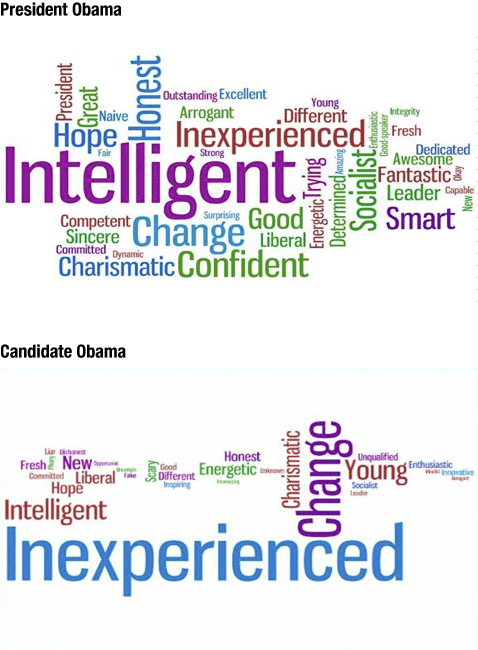
Americans are outraged at greedy financiers. Congresscritters are indignant. They're passing ill-advised, hastily prepared legislation. Sensing chum in the water, the pundits are circling around the Obama presidency like ravenous sharks.
And yet, the public is NOT taking it's anger out on Obama.


Showing posts with label Polls. Show all posts
Showing posts with label Polls. Show all posts
Tuesday, March 24, 2009


Wednesday, April 9, 2008
The GOP Playbook: "Mommy vs. Daddy"
Former Clinton strategist and pollster Dick Morris (the one who departed the Clinton inner circle before Mark Penn and has a long history as a hatchet man for the Republicans) has a revealing article in The Hill discussing a recent Gallup poll in which he selectively distorts the numbers to push the "Obama is weak/McCain is strong" narrative into the Beltway consiousness.
This poll was released by Gallup in mid-March under the headline, "Perceived Honesty Gap for Clinton Versus Obama, McCain." The pollsters summarized their findings as follows:
Ignoring the Positive: At this stage of the campaign, both candidates have a positive national image. Morris fails to note that both Obama and McCain exceed 50% on all but two questions. Obama almost cracks the 50% threshold on efficient management while McCain is only slightly under that mark on the "shares your values" question. Both fall short on the same question: Neither is viewed as having a clear plan for the country's future.
Redefine "Weak:" Fifty-six percent say Obama is a decisive leader and sixty-five percent says he has a clear vision for the country's future. Only in the view of a GOP-spinmeister could Obama's respectable and competitive numbers translate into being "weak."
Exaggerate the Negative or How deep is that "Strength"? Additionally, the points that McCain has "won" are likely to be very much in play once the Democratic nomination battle is settled and the Democrats turn their unified energies to McCain. It will be a Democratic priority to morph McCain's steadfastness into Bush's seven years of stubbornness. The Dems will also make the argument that the neocon laissez-faire economic ideology embraced by McCain simply amounts to four more years of Bush's disastrous domestic policies. Once this happens, I cannot see McCain maintaining a significant advantage on the leadership or management questions. Conversely, can anyone see McCain closing the gap on the "empathy" questions once the general election campaign is underway?
Morris fails to consider the dramatic changes underway within the 2008 electorate and dismisses the 2006 results. He basically admits the only path to a GOP presidential victory depends on convincing a majority of voters that foreign threats are more important than domestic economic concerns. Will the Republican Party be successful once again playing the politics of fear?
Perhaps counter-intuitively to progressive activists, Morris is correct in stating Iraq may be McCain's strongest (and perhaps only) winning general election issue. This is why Obama doesn't want to be talking about Iraq 24-7 in the summer and fall. He should (and I believe he will) focus on the economy.
This poll was released by Gallup in mid-March under the headline, "Perceived Honesty Gap for Clinton Versus Obama, McCain." The pollsters summarized their findings as follows:
It is clear that voters are able to distinguish among the three major presidential candidates and rate some areas as strengths and some areas as weaknesses for each. Clinton would appear to have more weaknesses in the public's eyes than McCain or Obama, though that might reflect the fact that she is a better-known figure (and has lower favorable ratings). Currently, she holds a significant lead over Obama on only 2 of the 10 character dimensions evaluated here (strong and decisive leader, and having a clear plan for solving the country's problems) and McCain on one (clear plan). Despite this, she remains competitive with McCain in general-election matchu.ps and she has held off Obama's attempts to wrap up the Democratic nomination
Morris chose to focus on the secondary headline, "McCain most likely to be viewed as a strong leader" and push this as the narrative. Just as the Rove Republican smear machine labeled Kerry as a "flip-flopper" in the spring of 2004, the 2008 strategy is to define Obama as weak and indecisive. It is important to understand this effort is already well underway. Morris even admits the Right needs to soften him up now for the general election campaign: "the pressure the right brings to bear on him will cause him to appear weak in the face of attacks."
But a close look at the numbers doesn't show a huge difference between Obama and McCain at this stage of the campaign. Let's look at the numbers Morris is using. According to Morris:
Obama won:
• Cares about the needs of people like you, 66% to 54%
• Shares your values, 51% to 46%
•Understands the problems Americans face in their daily lives, 67% to 55%
McCain won:
• Is a strong, decisive leader, 56% to 69%
• Is honest and trustworthy, 63% to 67%
• Can manage the government efficiently, 48% to 60%
Neither won:
• Has a clear plan for solving the country's problems, 41% to 42%
• Has a clear vision for the country's future, 67% to 65%
• Would work well with both parties in Washington to get things done, 62% to 61%
• Is someone you would be proud to have as president, 57% to 55%
The toe-sucker didn't indicate what the MoE was on this poll. It's plus or minus 3%, which means the separation between Obama and McCain on the "honest and trustworthy" and "shares your values" traits are statistically insignificant.
These numbers fit into one of Morris' favorite memes: Democrats are the (empathetic) Mommy Party and Republicans the (efficient) Daddy Party. The conclusions he draws are selectively simplistic and spun to fit into his oft-stated worldview. Morris goes once step further, diminishing Obama's general election chances and elevating McCain's by pulling out the Republican trump card, 9-11:
in an age of terrorism, weakness is a capital crime. McCain needs to base his campaign on establishing Obama’s weakness and his own strong leadership by comparison.Morris's analysis depends on spinning these numbers in three subtle (yet sinister) ways. Ignoring the positive, redefining the term "weak" and exaggerating the negative.
Ignoring the Positive: At this stage of the campaign, both candidates have a positive national image. Morris fails to note that both Obama and McCain exceed 50% on all but two questions. Obama almost cracks the 50% threshold on efficient management while McCain is only slightly under that mark on the "shares your values" question. Both fall short on the same question: Neither is viewed as having a clear plan for the country's future.
Redefine "Weak:" Fifty-six percent say Obama is a decisive leader and sixty-five percent says he has a clear vision for the country's future. Only in the view of a GOP-spinmeister could Obama's respectable and competitive numbers translate into being "weak."
Exaggerate the Negative or How deep is that "Strength"? Additionally, the points that McCain has "won" are likely to be very much in play once the Democratic nomination battle is settled and the Democrats turn their unified energies to McCain. It will be a Democratic priority to morph McCain's steadfastness into Bush's seven years of stubbornness. The Dems will also make the argument that the neocon laissez-faire economic ideology embraced by McCain simply amounts to four more years of Bush's disastrous domestic policies. Once this happens, I cannot see McCain maintaining a significant advantage on the leadership or management questions. Conversely, can anyone see McCain closing the gap on the "empathy" questions once the general election campaign is underway?
Morris fails to consider the dramatic changes underway within the 2008 electorate and dismisses the 2006 results. He basically admits the only path to a GOP presidential victory depends on convincing a majority of voters that foreign threats are more important than domestic economic concerns. Will the Republican Party be successful once again playing the politics of fear?
Perhaps counter-intuitively to progressive activists, Morris is correct in stating Iraq may be McCain's strongest (and perhaps only) winning general election issue. This is why Obama doesn't want to be talking about Iraq 24-7 in the summer and fall. He should (and I believe he will) focus on the economy.
Tuesday, December 18, 2007
Nine Out of Ten American Voters Surveyed Agree:
It's rare during this time of increased partisanship to find the American electorate agreeing on anything, but this morning a new presidential preference poll from USA Today/Gallup reveals a surprising consensus among American voters. Granted, the headlines from the poll are likely to be about a modest bounce in support for Hillary Clinton and a shift among Democratic voters towards nominating the "most electable" general election candidate.
But buried deeper in the poll is an intriguing number: Nine out of ten voters today say it makes a real difference to them who is elected president. This represents a huge swing (of more than 30 points) compared to polling data from previous election cycles:
A. Does it make a real difference to you who is elected president, or not?
But buried deeper in the poll is an intriguing number: Nine out of ten voters today say it makes a real difference to them who is elected president. This represents a huge swing (of more than 30 points) compared to polling data from previous election cycles:
A. Does it make a real difference to you who is elected president, or not?
| DATE | Yes | No | No opinion |
|---|---|---|---|
| 2007 Dec 14-16 | 90 | 10 | 0 |
| 2000 Mar 10-12 | 60 | 35 | 5 |
| 2000 Jan 7-10 | 54 | 37 | 9 |
| 1996 May 9-12 | 57 | 40 | 3 |
| 1992 Oct 23-25 | 76 | 22 | 2 |
| 1992 Sep 11-15 | 66 | 30 | 4 |
| 1992 Apr 20-22 | 53 | 43 | 4 |
| 1992 Feb 28-Mar 1 | 53 | 42 | 5 |
| 1992 Jan 6-9 | 60 | 30 | 10 |
Only in the closing weeks of the 1992 general election campaign did more than 2/3 of voters share the sentiment. Perhaps this number is a confirmation of the view 2008 may be truly be a "change election."
I can offer up three possible explanations for this change:
1) It is an indictment of the Bush administration's failed policies which have adversely affected the daily lives of American families. Even the most casual voter understands the stakes in the 2008 presidential election.
2) It is a reflection of the increased partisanship that has become a fixture in American politics over the past fifteen years. As we've gone to our separate corners and divided ourselves further apart on the ideological spectrum, the stark differences in governing philosophies have increased the importance of who resides at 1600 Pennsylvania Avenue.
3) The Global War on Terror is more than a bumper sticker slogan. Perhaps 9/11 did change everything. Since the USA Today poll doesn't include data for the 2004 cycle, perhaps this shift happened during the last cycle. If this is the case, I'm afraid we may end up with a President Rudy.
Any other explanations?
Sunday, December 9, 2007
The Sunday Muse
Three Items for the FUBAR File:
- American influence in the world continues its freefall thanks to BushCo foreign policy.
- Anyone else thinking it might be time to apply the "Three Strikes Law" to Democrats and their dismal failure to stand up to Bush/Cheney on an Iraq timeline?
- Today's WaPo is reporting senior Congressional Dems (including Pelosi) were briefed on CIA interrogation techniques back in 2002 and no one raised any concerns about waterboarding, making this week's call for an investigation into the disappearance of the interrogation videotapes somewhat disengenuous.
In Search of The 'New Girls' Network: The Wall Street Journal reports on Clinton's difficulty winning over successful, professional women.
No Longer a Dark Horse: I'll say it again: Huckabee's surge in Iowa (where evangelical voters are proving once again they will participate in politics as one cohesive voting bloc) is bad news for Democrats in the November general election.
A Primary Contest: If any additional evidence was necessary to show the Democratic nomination contest has morphed from a coronation march into a true battle, there's news of a dramatic shift in South Carolina (where Obama is now in a statistical tie with Clinton).
Subscribe to:
Posts (Atom)